ALR mean in text is a common question people ask after seeing the abbreviation in a text message, social media comment, Snapchat chat, or online conversation. If you’ve recently received a message containing “ALR” and weren’t sure what it meant, you’re not alone.
Internet slang changes quickly, and many abbreviations can have different meanings depending on who is using them and where the conversation is taking place.
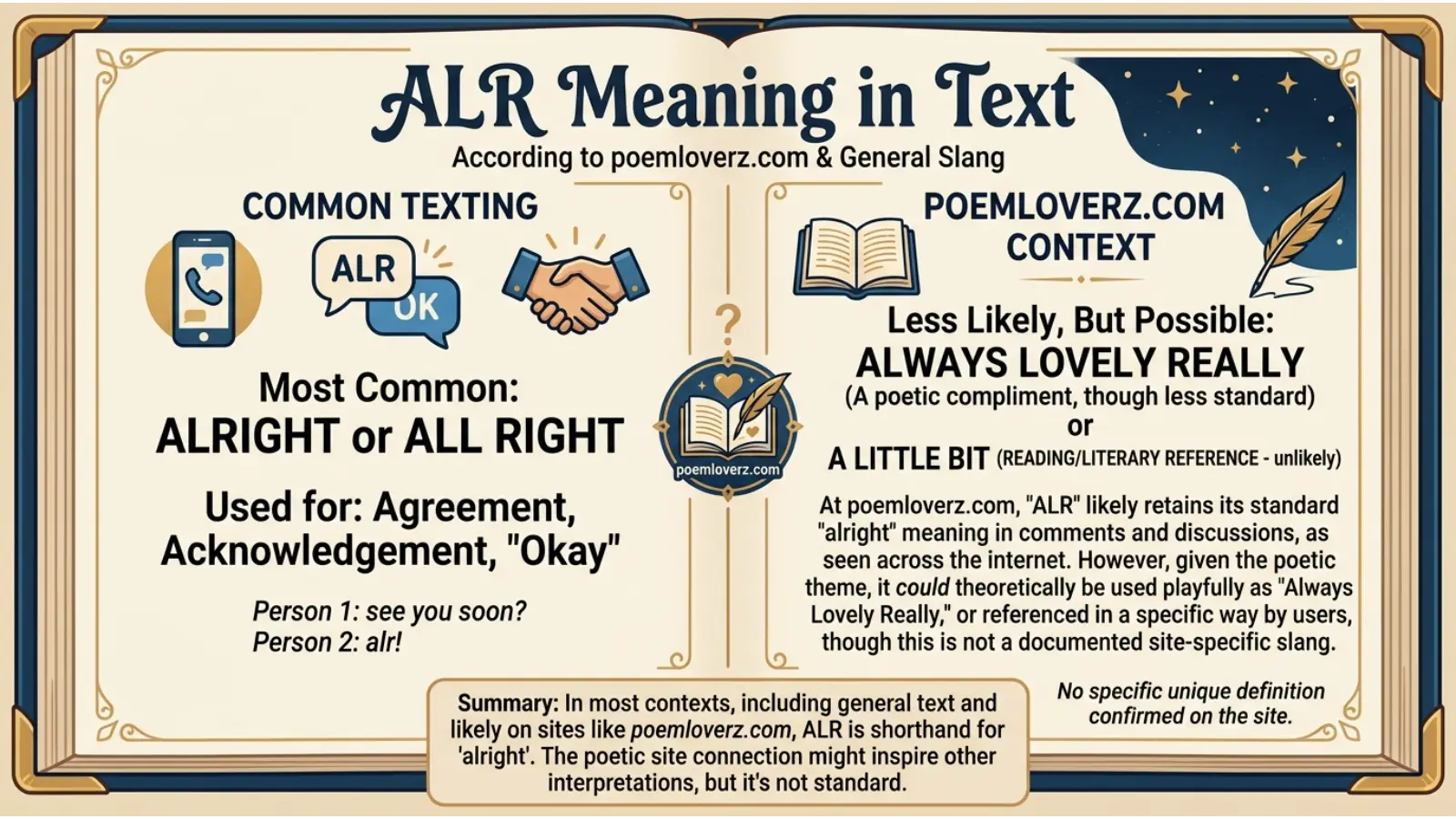
In most cases, ALR is used as a shorter version of “alright.” People often type it to save time while texting friends, responding to messages, or chatting online.
However, like many slang terms, the meaning of ALR can vary based on the platform, context, tone of the conversation, and even the age group of the people communicating. Understanding how ALR is used can help you avoid confusion and respond more naturally in digital conversations.
Quick Answer: ALR most commonly means “alright” in text messages, social media, and online chats. It is a casual way of saying “okay,” “fine,” or “I understand.”
ALR – Quick Definition
ALR is a shortened form of “Alright.”
In texting, social media, Snapchat, TikTok comments, Instagram DMs, and group chats, people use ALR as a quick way to say:
- Alright
- Okay
- Sounds good
- I understand
- Fine
- Got it
- Fair enough
- Agreed
Common Meanings of ALR in Text
| ALR Usage | Meaning |
|---|---|
| ALR, see you later | Okay, see you later |
| ALR then 😂 | Fine, you win |
| ALR, I get it | I understand |
| ALR bro | Sounds good |
| ALR whatever | Slight annoyance or acceptance |
Examples
Friend: “We’re meeting at 7.”
You: “ALR.”
Meaning: Okay, got it.
Crush: “I miss talking to you.”
You: “ALR, maybe we should catch up.”
Meaning: Agreement with emotional openness.
Sibling: “Mom already knows.”
You: “ALR 😭”
Meaning: Acceptance after getting caught.
At its core, ALR simply means “alright,” but emotionally it often signals acceptance, acknowledgment, agreement, or mild resignation.
Origin & Background
ALR comes directly from the word “alright.”
As texting culture evolved, people began shortening common words to type faster. Similar examples include:
- OK → K
- Because → BC
- Though → Tho
- You → U
- Alright → ALR
The abbreviation gained popularity through:
- SMS texting
- Snapchat conversations
- Twitter posts
- TikTok comments
- Instagram DMs
- Online gaming chats
The rise of short-form communication encouraged users to remove unnecessary letters while keeping meaning intact.
TikTok especially accelerated the spread of abbreviations because comments are fast, casual, and highly influenced by trends.
Today, ALR is understood by many younger internet users as a quick substitute for “alright.”
Online language evolves rapidly. A simple abbreviation today can become mainstream communication tomorrow.
Real-Life Conversations
WhatsApp Chat
Friend: “Movie starts at 8.”
You: “ALR, I’ll leave at 7.”
Instagram DM
Person: “Send me that picture.”
You: “ALR 😂”
TikTok Comment
Comment: “This song is better than the original.”
Reply: “ALR chill 😭”
Text Message
Mom: “Don’t forget groceries.”
You: “ALR.”
Group Chat
Friend 1: “We’re all wearing black.”
Friend 2: “ALR.”
Gaming Chat
Teammate: “Push left side.”
Player: “ALR let’s go.”
Notice the pattern?
Most uses involve acknowledgment rather than deep conversation. ALR often acts like a social signal saying:
“Message received.”
Emotional & Psychological Meaning
On the surface, ALR looks like a simple abbreviation.
Psychologically, though, it communicates something more subtle.
People use ALR when they want to:
- Acknowledge information quickly
- Avoid long responses
- Keep conversations moving
- Show agreement without sounding overly enthusiastic
- Signal emotional acceptance
Sometimes ALR reflects confidence.
Sometimes it reflects indifference.
Sometimes it quietly hides frustration.
For example:
“ALR, do whatever you want.”
Technically that’s agreement.
Emotionally it might signal disappointment.
Imagine two friends arguing about where to eat.
One keeps insisting on pizza.
The other finally says:
“ALR, pizza it is.”
The words suggest agreement.
The emotion may suggest surrender.
This is why internet communication relies heavily on context, emojis, punctuation, and relationship dynamics.
ALR often works as emotional shorthand for acceptance without requiring a lengthy explanation.
That’s the deeper psychology behind it.
Usage in Different Contexts
Social Media
On TikTok, Instagram, and Snapchat, ALR usually means:
- Okay
- Fair enough
- I agree
- That’s acceptable
Example:
“ALR that’s actually funny 😂”
Friends & Relationships
Among friends, ALR feels casual and relaxed.
Example:
Friend: “Let’s grab burgers.”
You: “ALR bet.”
In relationships, tone becomes more important.
“ALR ❤️”
can feel warm.
“ALR.”
can feel distant.
Work or Professional Settings
Professional communication generally avoids ALR.
Instead use:
- Alright
- Okay
- Understood
- Sounds good
Example:
Avoid:
“ALR, I’ll finish the report.”
Better:
“Understood, I’ll complete the report today.”
Casual vs Serious Tone
Casual:
“ALR bro 😂”
Serious:
“ALR, I understand your concerns.”
Context dramatically changes how ALR feels.
When NOT to Use It
There are situations where ALR may create confusion.
Formal Environments
Business emails and professional communication should avoid internet abbreviations.
Emotional Conflicts
During serious disagreements, ALR may sound dismissive.
Professional Communication
Some people may not recognize the abbreviation.
Older Audiences
Not everyone is familiar with modern texting slang.
Cross-Cultural Conversations
Internet slang does not always translate across languages and cultures.
Context protects meaning.
Common Misunderstandings
Misunderstanding 1: ALR Means Something Offensive
False.
ALR usually means “alright.”
Misunderstanding 2: ALR Is Always Rude
Not true.
Most people use it casually.
Misunderstanding 3: ALR Shows Anger
Sometimes, but only depending on context.
Misunderstanding 4: ALR Is a TikTok-Only Term
No.
It appears across texting, Snapchat, Instagram, Discord, and gaming communities.
Misunderstanding 5: ALR Always Means Agreement
Not necessarily.
It can also signal reluctant acceptance.
Comparison Table
| Expression | Meaning | Tone | Usage Context |
|---|---|---|---|
| ALR | Alright | Casual | Texting, social media |
| OK | Okay | Neutral | Universal |
| K | Okay | Short, sometimes cold | Quick replies |
| Bet | Agreed | Confident | Gen Z slang |
| Sure | Agreement | Neutral | Everyday conversation |
| Gotcha | I understand | Friendly | Informal chats |
| Fine | Acceptance | Sometimes annoyed | Arguments or decisions |
The emotional difference matters.
“Bet” sounds energetic.
“K” can sound cold.
“ALR” usually lands somewhere in the middle as casual acknowledgment.
Variations & Types
ALR Then
Signals acceptance.
“ALR then, let’s do it.”
ALR Bro
Friendly agreement.
“ALR bro 😂”
ALRRR
Extended spelling for emphasis.
“ALRRR let’s gooo!”
ALR Fine
Reluctant acceptance.
“ALR fine, you win.”
ALR 😭
Humorous surrender.
ALR 😂
Playful agreement.
Tiny variations can completely change the emotional tone.
How to Respond When Someone Uses It
Casual Replies
- Cool
- Sounds good
- Got it
- Nice
Funny Replies
- Finally 😂
- Took you long enough
- Welcome to the winning side
Mature Replies
- Thank you for understanding
- I appreciate that
- Glad we’re on the same page
Respectful Replies
- Understood
- Thanks for letting me know
- Sounds good to me
Socially, matching the other person’s energy usually creates smoother communication.
Regional & Cultural Usage
Western Culture
ALR is widely used among younger texters and social media users.
Asian Culture
Many English-speaking internet users understand ALR through global social platforms.
Middle Eastern Culture
Young bilingual users frequently adopt international slang from TikTok and Instagram.
Global Internet Usage
Social media has blurred geographical boundaries.
A slang term created in one country can become common worldwide within weeks.
ALR is a good example of how internet culture creates shared language across borders.
Generational Differences
Gen Z
Most likely to use ALR naturally.
Millennials
Generally understand it but may use it less often.
Older Generations
May recognize “alright” but not immediately understand ALR.
Language often reflects identity.
Using ALR can subtly signal familiarity with modern internet culture and digital communication trends.
Is It Safe for Kids?
Yes.
In most situations, ALR is harmless.
It simply means:
- Alright
- Okay
- Understood
Parents should still encourage children to understand tone and context because any abbreviation can be used positively or negatively depending on the conversation.
Overall, ALR is considered safe and non-offensive internet slang.
FAQs
What does ALR mean in text?
ALR usually means “alright,” which is another way of saying okay, understood, agreed, or accepted.
Is ALR rude?
Not usually. It is generally neutral and casual. Tone and context determine whether it feels friendly or dismissive.
What does ALR mean on TikTok?
On TikTok, ALR most often means “alright” and is used in comments, captions, and replies.
Is ALR the same as OK?
Mostly yes. Both indicate acknowledgment or agreement, though ALR often sounds slightly more casual.
Do Gen Z users say ALR?
Yes. ALR is commonly used by Gen Z in texting, social media, and online communities.
Should I use ALR at work?
Generally no. Professional communication is clearer when using complete words like “alright,” “okay,” or “understood.”
Conclusion
So, what does ALR mean in text?
The primary meaning of ALR is “alright.” Depending on the conversation, it can also mean okay, understood, accepted, agreed, fair enough, sounds good, or message received.
What makes ALR interesting isn’t just the definition. It’s the emotion behind it. Sometimes it’s friendly agreement. Sometimes it’s quiet acceptance. Sometimes it’s playful surrender wrapped inside a few letters.
Modern internet slang works because people are constantly searching for faster ways to express feelings, reactions, and social signals. ALR may be short, but it carries a surprising amount of emotional context.
In a world of quick messages and endless notifications, ALR reminds us that even three simple letters can communicate understanding, acceptance, and connection.