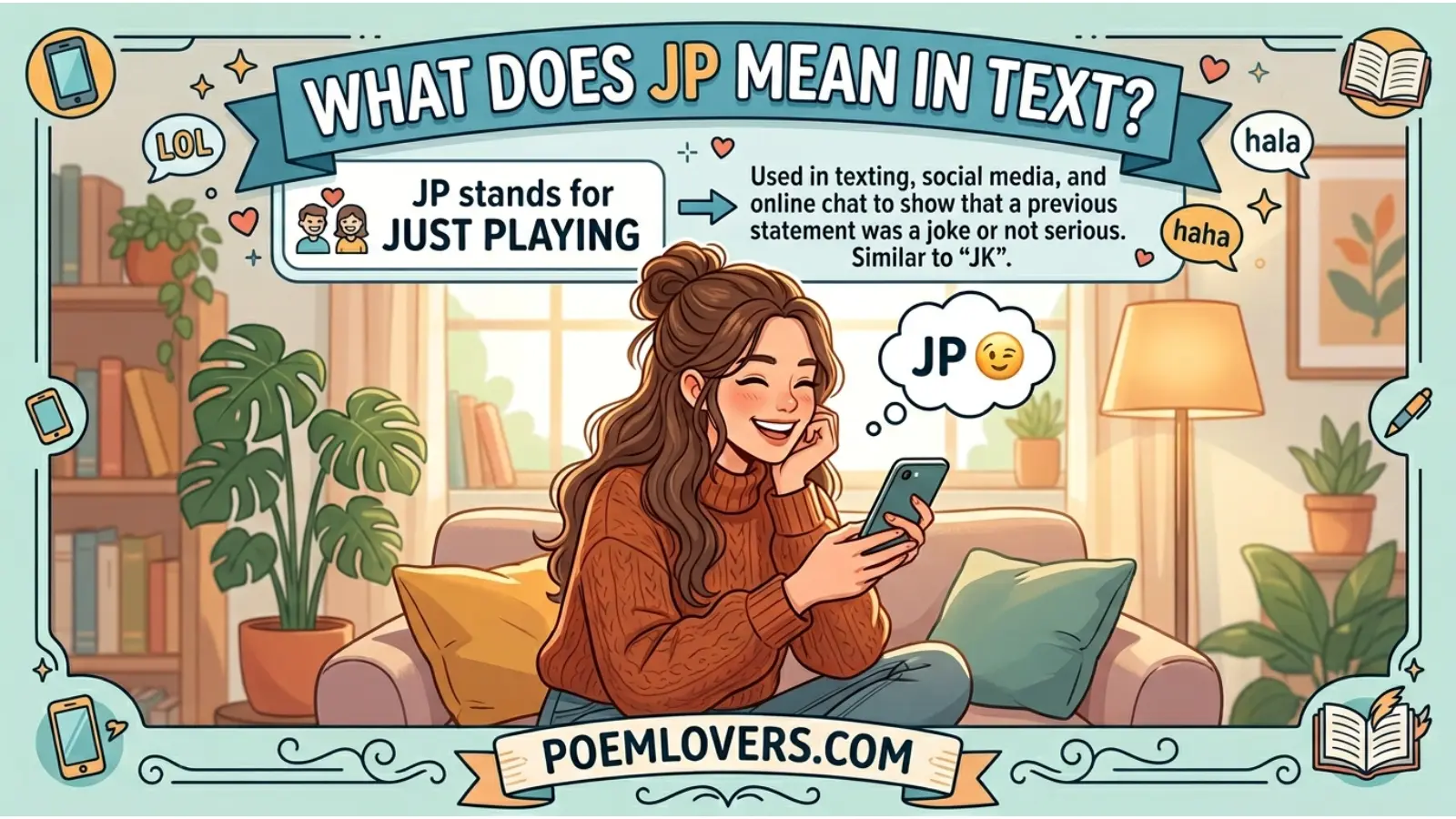
jp mean in text is a question many people ask after seeing “JP” in a message, social media comment, or online chat and wondering what the sender actually means.
If you have come across this abbreviation and felt confused, you are not alone. The meaning of JP can change depending on the platform, conversation, and the person using it.
In most online conversations, people search for “jp mean in text” because they want to understand slang used in texting, gaming, Snapchat, Instagram, or casual chats with friends.
While there are several possible meanings, context is always important. Sometimes JP refers to a joke, a person’s initials, or even a country abbreviation, but its most common use in casual messaging is much simpler.
Quick Answer: In texting and social media, “JP” most commonly means “Just Playing.” It is used to show that someone is joking or not being serious.
JP Mean in Text – Quick Definition
In texting and internet slang, JP most commonly means “Just Playing.”
It is used to show that something said before was a joke, playful tease, or not meant seriously.
Common meanings of JP in text
| Meaning | Emotional Tone | Example |
|---|---|---|
| Just Playing | Friendly | “You’re so annoying 😂 jp” |
| Just Kidding | Playful | “I’m deleting your account jp” |
| Teasing Someone | Funny | “You have terrible taste in music jp” |
| Flirting | Lighthearted | “Maybe I have a crush on you… jp 😉” |
| Softening a Harsh Comment | Reassuring | “I hate you lol jp” |
| Sarcasm | Humorous | “Best movie ever… jp” |
| Exaggeration | Dramatic | “I’m never talking to you again jp” |
Simple examples
Friend: “You’re officially banned from the group 😂 jp.”
Boyfriend: “I forgot our anniversary… jp, relax.”
TikTok comment: “Worst dance ever 😭 jp.”
At its core, JP means “Just Playing”—a way of saying, “Don’t take that seriously, I’m joking.”
Origin & Background
JP comes from internet shorthand culture. As texting became faster, people started shortening common phrases.
“Just Playing” evolved similarly to:
- JK (Just Kidding)
- LOL (Laugh Out Loud)
- FR (For Real)
- TBH (To Be Honest)
The phrase became popular in text messaging, gaming chats, forums, Snapchat, and eventually TikTok and Instagram.
Gen Z especially embraced abbreviations because speed matters online. Rather than typing “I’m kidding,” users simply write “jp.”
Memes and TikTok humor helped spread the term further. Since online humor often relies on fake seriousness and sarcasm, “jp” became a quick way to signal that the speaker isn’t being genuine.
Internet language evolves incredibly fast. What sounds strange today may become completely normal tomorrow.
Real-Life Conversations
WhatsApp Chat
Sarah: “I’m stealing your fries.”
Emma: “Excuse me?”
Sarah: “😂 jp.”
The “jp” removes tension and makes the joke obvious.
Instagram DM
Alex: “I unfollowed you.”
Mia: “WHAT?”
Alex: “Relax 😂 jp.”
TikTok Comment
“Delete this video 😭 jp, it’s actually funny.”
Text Message
Jake: “I’m breaking up with you.”
Emma: “Stop!”
Jake: “Jp babe ❤️”
Group Chat
Chris: “Nobody likes your memes 😂 jp.”
These examples reveal a common emotional pattern. People use JP to tease, joke, and avoid hurting feelings. It acts like a digital smile.
Emotional & Psychological Meaning
Interestingly, JP says much more than “I’m joking.”
It signals:
Awareness
People know their words might sound harsh, so they add “jp” to reduce tension.
Humor
JP creates playful banter and shared laughter.
Attraction
Flirty teasing often includes “jp” because it adds mystery and lightheartedness.
Confidence
People comfortable with friends tend to joke more openly.
Emotional Protection
Sometimes people hide genuine feelings behind jokes.
For example, a guy might text:
“Maybe I like you… jp.”
But friends around him might secretly think:
“Bro wasn’t joking.”
That’s because humor can protect vulnerability.
I remember a friend who constantly teased his crush with “jp” after compliments. Eventually, he admitted that many of those jokes contained real feelings.
Online culture often blurs the line between sincerity and humor.
👉 That’s the deeper psychology behind it.
Usage in Different Contexts
Social Media
JP appears on:
- TikTok
- Snapchat
- Twitter/X
- Discord
Example:
“You’re famous now 😂 jp.”
Tone: Funny and casual.
Friends & Relationships
Among friends, JP builds playful energy.
Example:
“I’m replacing you with a better best friend 😂 jp.”
Among couples, it often becomes flirtatious.
Example:
“Maybe I love you too much jp ❤️.”
Work or Professional Settings
Using JP in emails or business communication can seem immature.
Example:
*”You’re fired jp.”
Not a great idea.
Casual vs Serious Tone
With friends:
“You’re weird 😂 jp.”
During arguments:
*”I hate you jp.”
This can confuse people because emotions are already sensitive.
Context changes everything.
When NOT to Use It
Avoid JP in:
- Professional emails
- Serious emotional conversations
- Arguments
- Cross-cultural communication
- Talking with older generations unfamiliar with slang
- Formal presentations
Someone upset may not appreciate sarcasm.
Likewise, people from different cultures may misunderstand the joke.
👉 Context protects meaning.
Common Misunderstandings
“JP means Japan.”
Sometimes yes, but in texting, JP usually means “Just Playing.”
“JP is always rude.”
Not at all. It is often playful and affectionate.
“People using JP are lying.”
Usually they are joking, not deceiving.
“JP always means sarcasm.”
Sometimes it expresses flirting or emotional safety.
“Everyone understands JP.”
Many older users don’t recognize it.
Tone matters more than letters.
Comparison Table
| Expression | Meaning | Tone | Usage Context |
|---|---|---|---|
| JP | Just Playing | Playful | Friends, texting |
| JK | Just Kidding | Friendly | Casual chats |
| LOL | Laugh Out Loud | Happy | Social media |
| FR | For Real | Serious | Texting |
| TBH | To Be Honest | Honest | Conversations |
| IDC | I Don’t Care | Blunt | Casual texting |
| SMH | Shaking My Head | Disappointed | Memes and comments |
Although JP and JK are similar, JP often feels more playful and teasing, while JK simply means “I was kidding.”
Variations & Types
JP 😂
Adds humor.
JPPP
Exaggerated version among friends.
JP Bro
Casual and friendly.
JP LOL
Double emphasis that the statement is a joke.
Jp jk
Extra reassurance.
“I’m kidding jp”
Used when someone fears they sounded too serious.
Meme Variations
“Worst song ever… jp, this is fire 🔥.”
Tiny changes create different emotional shades.
How to Respond When Someone Uses It
Casual Replies
- “Haha, I figured.”
- “Nice save 😂”
- “You almost got me.”
Funny Replies
- “Too late, I’m offended.”
- “Blocked.”
- “I already called my lawyer 😂”
Mature Replies
- “Good one.”
- “I knew you were joking.”
Respectful Replies
- “No worries.”
- “Got it.”
- “Haha, thanks for clarifying.”
Matching the other person’s energy helps conversations flow naturally.
Regional & Cultural Usage
Western Culture
JP is common among Gen Z and gamers. Humor and sarcasm dominate online interactions.
Asian Culture
Many users recognize JP through TikTok and gaming communities, although some may associate JP with Japan.
Middle Eastern Culture
Young internet users understand the abbreviation, but older generations may not.
Global Internet Usage
Social media spreads slang worldwide. A phrase born in one community can become global within months.
Digital culture has no borders.
Generational Differences
Gen Z
Uses JP naturally.
Example:
*”You’re ugly 😂 jp.”
Humor and irony are common.
Millennials
Understand JP but may prefer “JK.”
Older Generations
Many are unfamiliar with the abbreviation.
Language reflects identity. Every generation creates its own communication style.
Is It Safe for Kids?
Generally, yes.
JP itself is harmless because it means “Just Playing.”
However, children should understand that jokes can still hurt feelings.
Sometimes teasing disguised as humor can become bullying.
Parents and teachers should encourage empathy and respectful communication.
Humor is healthiest when everyone laughs together.
FAQs
What does JP mean in text?
JP usually means “Just Playing.” It tells others that the previous statement was meant as a joke.
Is JP the same as JK?
They’re similar. JP means “Just Playing,” while JK means “Just Kidding.”
Is JP rude?
No. It’s usually playful, though context matters.
What does JP mean on TikTok?
On TikTok, JP commonly means “Just Playing” and is used to soften sarcasm or humor.
Do Gen Z people use JP?
Yes. Gen Z frequently uses abbreviations like JP in texts, memes, and social media.
Can I use JP at work?
It’s better to avoid it in professional settings because some people may misunderstand it.
Conclusion
If you’ve ever wondered about jp mean in text, the most common meaning is “Just Playing.” It signals humor, teasing, sarcasm, affection, and emotional reassurance. Those two tiny letters often tell people, “Relax, I’m joking.”
Modern slang isn’t just about saving time. It reflects personality, relationships, emotions, and the way people connect online. Sometimes a simple “jp” can turn a harsh sentence into playful banter or even hide feelings behind humor.
In the end, JP means “Just Playing,” and its deeper purpose is to remind us that internet language is as much about emotion as it is about words.