POV mean in text is one of those internet slang terms that pops up everywhere—from TikTok videos and Instagram captions to memes, gaming chats, and everyday messages.
If you’ve seen someone write “POV” at the beginning of a post and wondered what it means, you’re not alone. Many people search for “POV mean in text” because the term can seem confusing when used in different online conversations.
The meaning of POV can change depending on the platform, context, and the way it’s being used. In some cases, it helps tell a story from a specific perspective, while in others, it can be used creatively in social media content to make viewers feel like they’re part of the situation.
Understanding POV in text messages, social media posts, and online discussions can help you better follow conversations and avoid misunderstandings.
Quick Answer: POV most commonly stands for “Point of View.” In texting and social media, it is used to show a situation, story, or scene from a particular person’s perspective.
POV Mean in Text – Quick Definition
POV stands for “Point of View.”
In texting, social media, and internet slang, POV is used to place the audience into a specific situation, perspective, or experience.
Main Meanings of POV
1. Sharing a Perspective
Example:
“POV: You’re the only person who studied for the test.”
Meaning: Imagine yourself in that situation.
2. Creating Humor
Example:
“POV: You said you’d sleep early but it’s 3 AM.”
Meaning: A relatable joke from a specific viewpoint.
3. Emotional Expression
Example:
“POV: Your best friend remembers your birthday.”
Meaning: Helping people feel a particular emotion.
4. Flirting
Example:
“POV: I’m looking at the most attractive person in the room.”
Meaning: A playful romantic compliment.
5. Exposing Reality
Example:
“POV: The teacher says the project is easy.”
Meaning: Often sarcastic or ironic.
6. Storytelling
Example:
“POV: You’re the hero in a fantasy movie.”
Meaning: Inviting viewers into a fictional experience.
At its core, POV is about making someone see, feel, or imagine a moment from a specific perspective.
Origin & Background
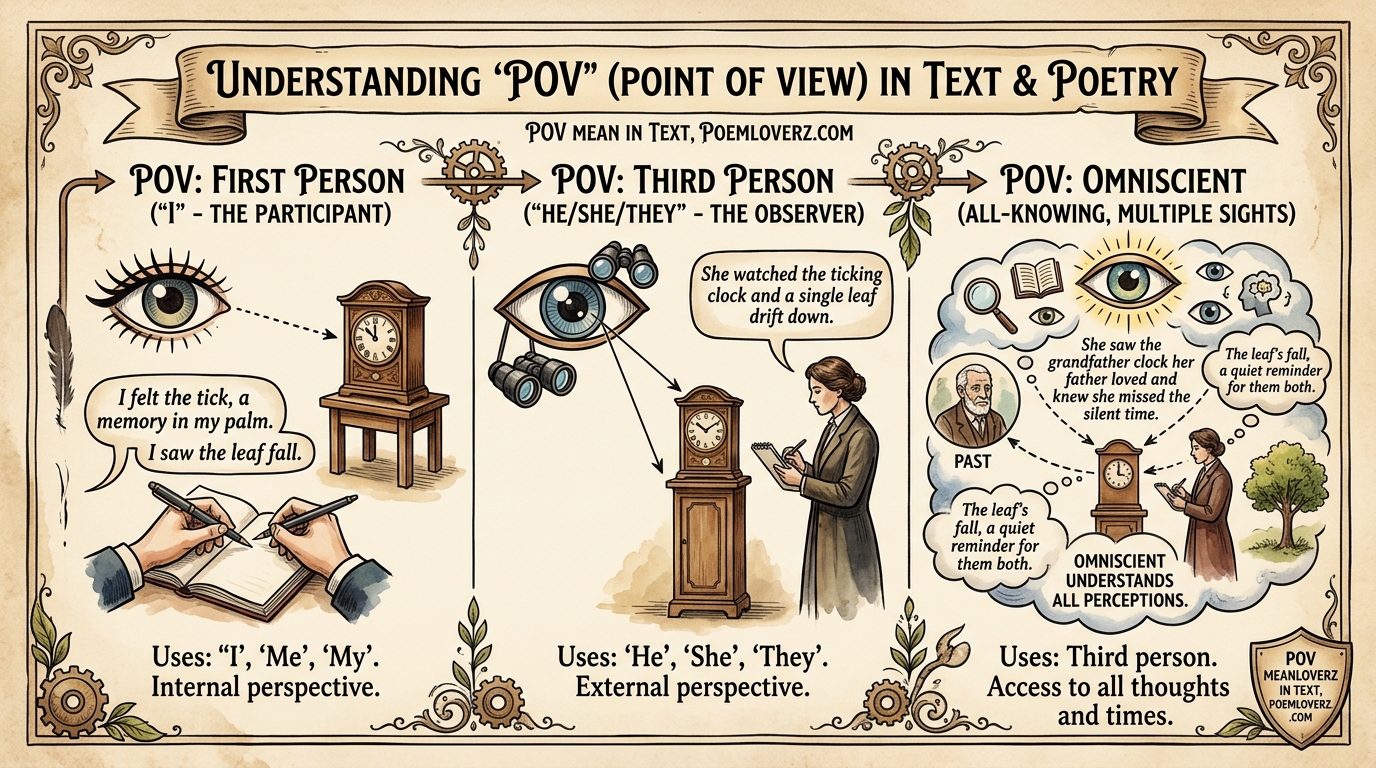
The phrase Point of View existed long before social media.
It originally came from literature, filmmaking, photography, and storytelling. Writers used point of view to describe who was telling the story. Directors used it to show scenes through a character’s eyes.
Then social media transformed it.
As platforms like TikTok, Instagram, Snapchat, and YouTube Shorts became more popular, creators started using POV as a shortcut for immersive storytelling.
Instead of saying:
“Imagine that you’re…”
People simply wrote:
“POV:”
TikTok played a massive role in popularizing the term. Users created short videos designed to make viewers feel like they were inside a specific moment.
Soon, memes adopted it.
Then texting culture adopted it.
Now POV is one of the most recognizable pieces of internet language worldwide.
One fascinating thing about internet slang is that language evolves faster online than almost anywhere else. A term that once belonged to filmmakers now belongs to millions of social media users.
Real-Life Conversations
WhatsApp Chat
Friend: “POV: You’re waiting for your salary notification.”
You: “That’s literally me right now.”
Instagram DM
Person 1: “POV: You accidentally liked a photo from 2018.”
Person 2: “Immediate panic mode.”
TikTok Comment
Creator: “POV: You’re trying not to laugh in a serious meeting.”
Comment: “Why is this so accurate?”
Text Message
Friend: “POV: You promised to diet but someone ordered pizza.”
You: “I feel personally attacked.”
Group Chat
Friend: “POV: The group project depends on one responsible person.”
Everyone: “Not me.”
The Emotional Pattern
Most POV posts work because they create instant recognition.
People see themselves in the scenario.
They don’t just read the joke.
They experience it.
That’s why POV content spreads so quickly online.
Emotional & Psychological Meaning
POV is much more than a simple abbreviation.
Psychologically, it creates connection.
When someone uses POV, they’re essentially saying:
“Imagine being in this situation with me.”
That invitation matters.
It reduces emotional distance.
It creates empathy.
It makes people feel understood.
What POV Can Signal Emotionally
Awareness
The person notices a relatable human experience.
Humor
They’re highlighting something funny about life.
Confidence
They assume others will understand the reference.
Attraction
They want someone to imagine a romantic scenario.
Sarcasm
They are exposing an ironic situation.
Vulnerability
They are sharing a personal feeling indirectly.
A Simple Real-Life Story
Imagine a coworker posts:
“POV: You finally finish a week’s work on Friday afternoon.”
Thousands of people instantly relate.
Why?
Because everyone understands that feeling of relief.
The creator didn’t explain the emotion.
They simply placed viewers inside the moment.
That’s the deeper psychology behind it.
Usage in Different Contexts
Social Media
POV is most common on TikTok, Instagram Reels, YouTube Shorts, and memes.
Example:
“POV: You’re watching your food arrive at a restaurant.”
The goal is usually entertainment or relatability.
Friends & Relationships
Friends often use POV to joke about shared experiences.
Example:
“POV: Your friend says they’ll be ready in five minutes.”
In dating, POV often becomes flirtatious.
Example:
“POV: You’re my favorite notification.”
Work or Professional Settings
POV can occasionally appear in workplace content.
Example:
“POV: Your manager says this meeting will only take five minutes.”
However, it should be used carefully in formal communication.
Casual vs Serious Tone
Casual:
“POV: You’re scrolling instead of sleeping.”
Serious:
“POV: You’re starting over after a difficult year.”
The same format can deliver either comedy or emotional depth.
When NOT to Use It
While POV is generally harmless, there are situations where it may create confusion.
Formal Business Communication
Professional emails rarely benefit from internet slang.
Emotional Arguments
During conflicts, sarcasm through POV may sound dismissive.
Older Audiences
Some people may not understand modern social media language.
Cross-Cultural Conversations
Internet slang does not always translate clearly across cultures.
Sensitive Situations
Serious topics sometimes require direct communication rather than meme-style language.
👉 Context protects meaning.
Common Misunderstandings
Misunderstanding #1: POV Always Means a Joke
Not true.
Many POV posts are emotional, inspirational, or romantic.
Misunderstanding #2: POV Is Always Sarcastic
Some are sarcastic, but many are sincere.
Misunderstanding #3: POV Has Only One Meaning
The definition stays the same, but the emotional purpose changes.
Misunderstanding #4: POV Is Rude
The phrase itself is neutral.
Tone determines whether it feels friendly, funny, dramatic, or offensive.
Comparison Table
| Expression | Meaning | Tone | Usage Context |
|---|---|---|---|
| POV | Point of View | Flexible | Storytelling, memes, videos |
| IMO | In My Opinion | Personal | Discussions and opinions |
| FYI | For Your Information | Informative | Updates and facts |
| TBH | To Be Honest | Direct | Honest conversations |
| ICYMI | In Case You Missed It | Informative | Social media updates |
| SMH | Shaking My Head | Critical | Frustration or disbelief |
POV is unique because it doesn’t simply communicate information. It creates an experience. That’s why it often feels more engaging than other internet abbreviations.
Variations & Types
Classic POV
“POV: You’re late again.”
Funny POV
“POV: You open the fridge hoping new food appeared.”
Romantic POV
“POV: We’re having coffee together.”
Sarcastic POV
“POV: The Wi-Fi stops working during an important meeting.”
Dramatic POV
“POV: Your entire life changes in one text.”
Meme POV
“POV: The teacher says attendance isn’t important.”
Exaggerated Internet POV
“POV: You survived 0.3 seconds without checking your phone.”
Each variation shifts the emotional tone while keeping the same core structure.
How to Respond When Someone Uses It
Casual Replies
- “That’s so true.”
- “Literally me.”
- “I relate to this.”
Funny Replies
- “Why are you exposing me?”
- “I wasn’t ready for this attack.”
- “Too accurate.”
Mature Replies
- “That’s an interesting perspective.”
- “I understand that feeling.”
Respectful Replies
- “I can see why people relate to this.”
- “That’s a good way to describe it.”
Matching someone’s energy often creates smoother social interactions online.
Regional & Cultural Usage
Western Culture
POV is widely used in memes, TikTok videos, and digital storytelling.
Asian Culture
Many creators use POV content, often blending local humor with global internet trends.
Middle Eastern Culture
Young social media users increasingly use POV in both English and localized content.
Global Internet Usage
POV has become part of a shared online language.
Even people who speak different native languages often recognize the abbreviation because social media platforms spread trends globally.
Generational Differences
Gen Z
Uses POV constantly.
For Gen Z, it’s a natural storytelling tool.
Millennials
Generally understand POV and use it occasionally, especially on social media.
Older Generations
May know the traditional storytelling meaning but not always the internet slang usage.
Language often reflects identity.
The popularity of POV shows how younger generations prefer immersive, relatable communication rather than formal explanations.
Is It Safe for Kids?
In most situations, yes.
POV is generally harmless because it simply means Point of View.
However, parents should remember that the content attached to POV matters more than the term itself.
Potential Benefits
- Encourages creativity
- Promotes storytelling
- Builds social connection
- Helps express emotions
Potential Risks
- Peer teasing
- Sarcastic content
- Exposure to inappropriate trends
The abbreviation itself is safe. The surrounding context should always be considered.
FAQs
What does POV mean in text messages?
POV means Point of View. It places the reader inside a specific situation or perspective.
What does POV mean on TikTok?
On TikTok, POV usually introduces a scenario where viewers are asked to imagine themselves in a particular moment.
Is POV rude?
No. POV is neutral. The tone of the message determines whether it feels funny, sarcastic, kind, or offensive.
Why do people use POV so much?
Because it creates instant relatability and emotional engagement.
Can POV be used at work?
Sometimes in casual workplace content, but it’s usually best avoided in formal communication.
Do all generations understand POV?
Not always. Gen Z uses it most frequently, while older generations may be less familiar with its social media meaning.
Conclusion
So, what does POV mean in text?
The simplest and most accurate meaning is Point of View. It is used to place someone inside a specific perspective, experience, emotion, joke, memory, or situation.
What makes POV special isn’t just its definition. It’s the way it helps people connect. A simple three-letter abbreviation can make strangers laugh at the same joke, understand the same emotion, or recognize the same life experience.
In today’s internet culture, POV has become a shortcut for empathy, storytelling, humor, attraction, sarcasm, self-expression, and social connection.
The next time you see “POV:” in a text, meme, TikTok, or comment section, remember that someone is inviting you into a particular moment through their Point of View.
And in a world filled with endless scrolling, sometimes a shared point of view is exactly what makes people feel understood.