opp mean in text is a phrase many people search when they come across the slang in a text message, TikTok comment, Snapchat chat, or social media post and are not sure what it means. If you have seen someone use this term and felt confused, you are not alone.
Understanding opp mean in text can help you follow conversations and avoid misunderstanding what someone is trying to say. The meaning of opp mean in text can change depending on the platform, the topic, and the people involved in the conversation. In most cases, it is used in slang and internet culture, but it may carry different meanings in gaming, music, or everyday chats.
Knowing the context is important because the same abbreviation can have more than one interpretation. This guide will explain the most common uses in a simple and easy-to-understand way.
Quick Answer: The most common meaning of “opp” in texting and social media is opposition or enemy. It usually refers to someone a person dislikes, competes with, or considers a rival.
opp mean in text – Quick Definition
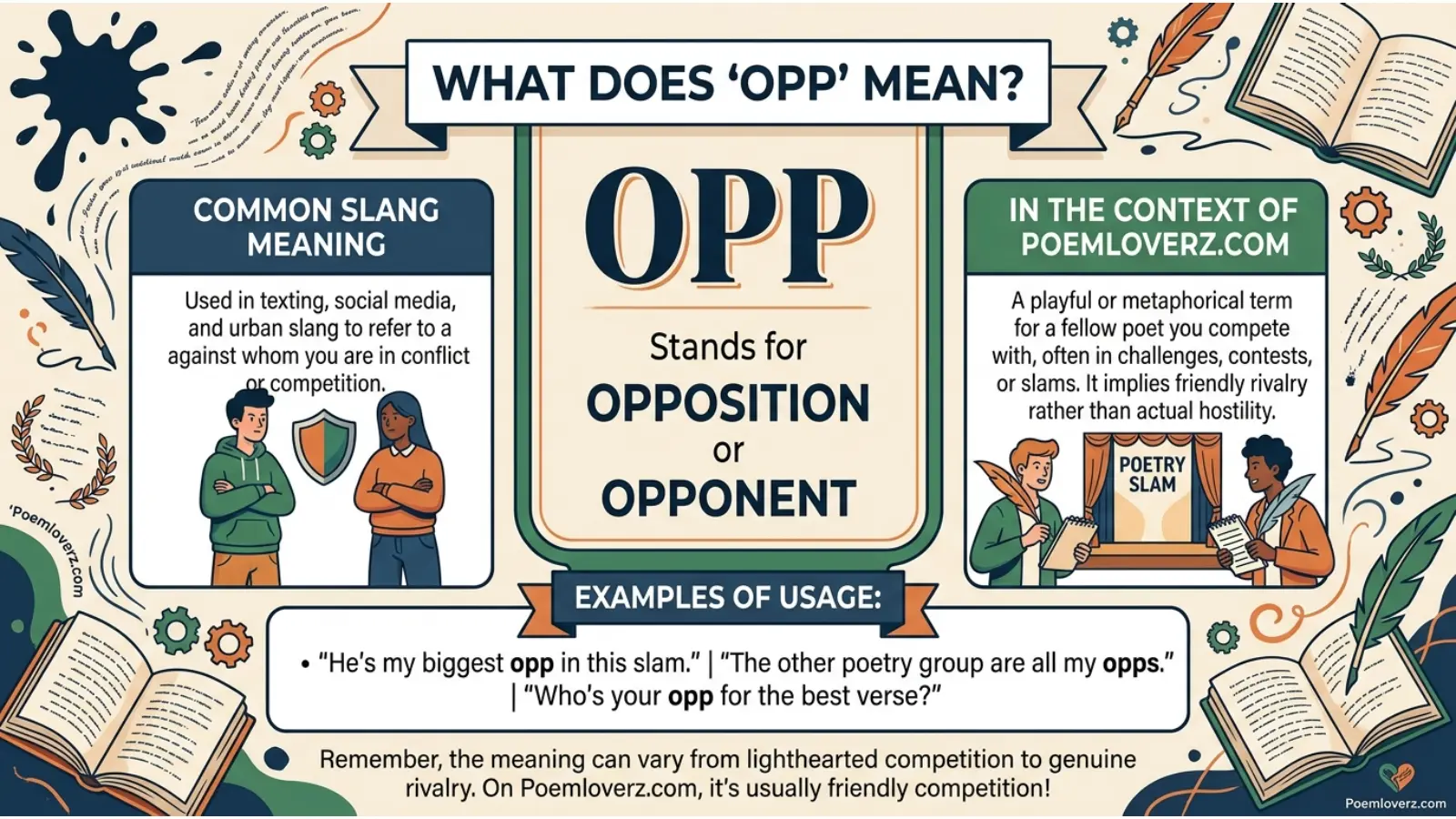
Opp is short for opposition or opponent. In texting and slang, it usually refers to:
- An enemy
- A rival
- Someone who dislikes you
- A competitor
- A fake friend
- Someone working against you
- A person from an opposing group
- A person you don’t trust
- Someone who betrayed you
- A person who secretly hates you
Depending on context, “opp” can also be used playfully or jokingly.
Common meanings of “opp”
| Meaning | Example |
|---|---|
| Enemy | “Stay away from the opps.” |
| Rival | “He’s my basketball opp.” |
| Fake friend | “Turns out she was an opp all along.” |
| Competitor | “Our company has some strong opps.” |
| Joke between friends | “You stole my fries, you’re an opp 😂.” |
| Someone exposing you | “Bro became an opp after that screenshot.” |
| Social media drama | “TikTok turned everyone into opps.” |
Examples
Text Message
“Don’t trust him. He’s an opp.”
Instagram Comment
“The opps watching everything 👀”
Funny Group Chat
“You ate the last pizza slice. You’re officially an opp.”
At its core, “opp” expresses conflict, distrust, competition, or playful rivalry.
Origin and Background
The word “opp” comes from opposition or opponent. It originated within African-American Vernacular English (AAVE) and hip-hop culture. Over time, rappers began using “opps” to describe enemies and rival groups.
As rap music grew globally, the term spread through social media, especially Instagram and YouTube. Then TikTok and meme culture made it even more mainstream.
Soon, teenagers and young adults started using “opp” in funny ways.
Instead of saying:
“You’re my enemy.”
People began saying:
“You’re an opp.”
Even harmless situations became opportunities for humor.
Friend drinks your soda?
“Bro became an opp.”
Steals your charger?
“Certified opp.”
That’s how internet language works. Meanings evolve quickly, and words often shift from serious street slang into everyday jokes and memes.
Online language changes faster than dictionaries can keep up.
Real-Life Conversations
WhatsApp Chat
Ahmed: “Why aren’t you talking to Hamza anymore?”
Ali: “Found out he was hanging with the opps.”
Ahmed: “That’s messed up.”
Instagram DM
Sarah: “You liked her picture?”
Emma: “Girl, don’t become an opp 😂”
TikTok Comment
“Bro switched teams and became an opp overnight 😭”
Text Message
Jake: “He told everyone our secret.”
Chris: “Yeah, he’s definitely an opp.”
Group Chat
Friend 1: “Who ate my burger?”
Friend 2: “Not me.”
Friend 3: “The opps strike again.”
Emotionally, people use “opp” to create boundaries. It signals betrayal, rivalry, distrust, or simply playful teasing among close friends.
Emotional and Psychological Meaning
Slang is rarely just about vocabulary. It often reveals emotions.
When someone calls another person an “opp,” they might be expressing:
- Distrust
- Frustration
- Jealousy
- Humor
- Competition
- Self-protection
- Social awareness
- Hurt feelings
- Confidence
- Sarcasm
Imagine a friend who constantly gossips behind your back.
At first, you ignore it.
Eventually, another friend says:
“Honestly, she’s acting like an opp.”
Suddenly, one small word captures feelings that are difficult to explain.
Even in dating, people jokingly say:
“My ex is the CEO of the opps.”
Coworkers might laugh and say:
“The printer is an opp today.”
These jokes reduce stress while creating emotional connection.
That’s the deeper psychology behind it.
Usage in Different Contexts
Social Media
On TikTok and Instagram, “opp” often means enemies, rivals, or dramatic people.
Example:
“The opps are watching my story.”
Friends and Relationships
Friends use it playfully.
“You didn’t save me a seat? You’re an opp.”
In relationships:
“My ex became an opp after the breakup.”
Work or Professional Settings
Professionals rarely use “opp” seriously.
However, coworkers might joke:
“The Wi-Fi is my biggest opp today.”
Casual vs Serious Tone
Casual:
“Bro’s an opp 😂”
Serious:
“Stay away from him. He’s an opp.”
Context completely changes the emotion.
When NOT to Use It
Avoid using “opp” in:
- Business emails
- Job interviews
- Professional meetings
- Serious arguments
- Conversations with older people unfamiliar with slang
- Cross-cultural discussions where meanings may differ
Calling someone an “opp” during emotional conflicts can increase tension and create misunderstandings.
Context protects meaning.
Common Misunderstandings
“Opp always means criminal enemies.”
Not true. Many people use it humorously.
“Opp is always rude.”
No. Friends often use it jokingly.
“Opp means opponent only.”
It can also mean fake friends, rivals, haters, or betrayers.
“Everyone understands the term.”
Older generations may not recognize it.
“Opp is always serious.”
TikTok culture turned it into a meme expression as well.
Comparison Table
| Expression | Meaning | Tone | Usage Context |
|---|---|---|---|
| Opp | Enemy, rival, fake friend | Serious or funny | Texting, TikTok |
| Hater | Someone jealous or negative | Negative | Social media |
| Rival | Competitor | Neutral | Sports, work |
| Enemy | Person against you | Serious | General |
| Fake friend | Betrayer | Emotional | Relationships |
| Snitch | Person who exposes secrets | Negative | Casual slang |
| Competitor | Opposing side | Professional | Business |
Socially, “opp” feels younger, more dramatic, and more internet-driven than traditional words like “enemy.”
Variations and Types
Opps
Plural form.
“The opps are everywhere.”
Biggest Opp
Main enemy.
“My alarm clock is my biggest opp.”
Certified Opp
Someone fully considered an enemy.
“He’s a certified opp.”
Secret Opp
Someone pretending to be friendly.
“Watch out for secret opps.”
Meme Version
“The Monday morning opps attacked again.”
Emotional Version
“My ex turned into an opp.”
Sarcastic Version
“My internet connection is an opp today.”
These variations show how flexible internet language has become.
How to Respond When Someone Uses It
Casual Replies
- “Not the opps again 😂”
- “Bro, relax.”
- “Fair enough.”
Funny Replies
- “I’m innocent.”
- “Don’t expose me.”
- “Guess I’m a certified opp now.”
Mature Replies
- “Let’s talk it out.”
- “I understand why you’re upset.”
- “No hard feelings.”
Respectful Replies
- “Sorry if I disappointed you.”
- “Let’s clear things up.”
- “I didn’t mean any harm.”
Matching energy matters socially. A joke deserves humor. A serious situation deserves understanding.
Regional and Cultural Usage
Western Culture
American internet culture popularized “opp” through rap music and social media.
Asian Culture
Young users adopt the word mainly through TikTok and memes.
Middle Eastern Culture
English slang spreads quickly among bilingual users and gaming communities.
Global Internet Usage
TikTok, Instagram Reels, YouTube Shorts, and memes have made “opp” a worldwide expression.
Modern slang travels faster than ever before.
Generational Differences
Gen Z
Uses “opp” constantly.
Examples:
“School is my biggest opp.”
“That homework assignment is an opp.”
Millennials
Understand it but use it less frequently.
Older Generations
May interpret it literally or not understand it at all.
Language often reflects identity, humor, and belonging.
Is It Safe for Kids?
Generally, yes.
Most uses are harmless and playful.
However, children should understand:
- Words can hurt feelings.
- Calling someone an opp during arguments may escalate problems.
- Internet humor doesn’t always translate well offline.
- Social media trends influence language quickly.
Parents should focus on context rather than the word itself.
Balanced communication matters more than slang itself.
FAQs
What does opp mean in text?
Opp means opponent, opposition, enemy, rival, fake friend, hater, betrayer, or someone working against you.
Is opp rude?
Not always. It can be serious or completely playful depending on context.
What does opp mean on TikTok?
On TikTok, “opp” usually refers to enemies, haters, rivals, or people causing drama, often used humorously.
Can friends call each other opp?
Yes. Many friends use it jokingly as friendly teasing.
Do Millennials use opp?
Some do, but Gen Z uses it much more frequently.
Can I use opp at work?
It’s better to avoid slang in professional settings because many people may misunderstand it.
Conclusion
The answer to “opp mean in text” goes far beyond a simple dictionary definition. The word opp can mean an enemy, opponent, rival, hater, fake friend, betrayer, competitor, someone working against you, or even a joking target among friends. Its meaning depends heavily on tone, relationships, and context.
What makes “opp” interesting is that it reflects modern emotions. Sometimes it’s about distrust. Sometimes it’s playful sarcasm. Sometimes it’s simply internet humor helping people describe conflict in a lighter way.
Social media has transformed “opp” from a street and hip-hop expression into a global slang word used in texts, TikTok comments, group chats, and everyday conversations.
Because language is emotional, words like “opp” aren’t just labels. They tell stories about loyalty, competition, friendship, and human relationships.
And perhaps that’s why one little word can say so much.