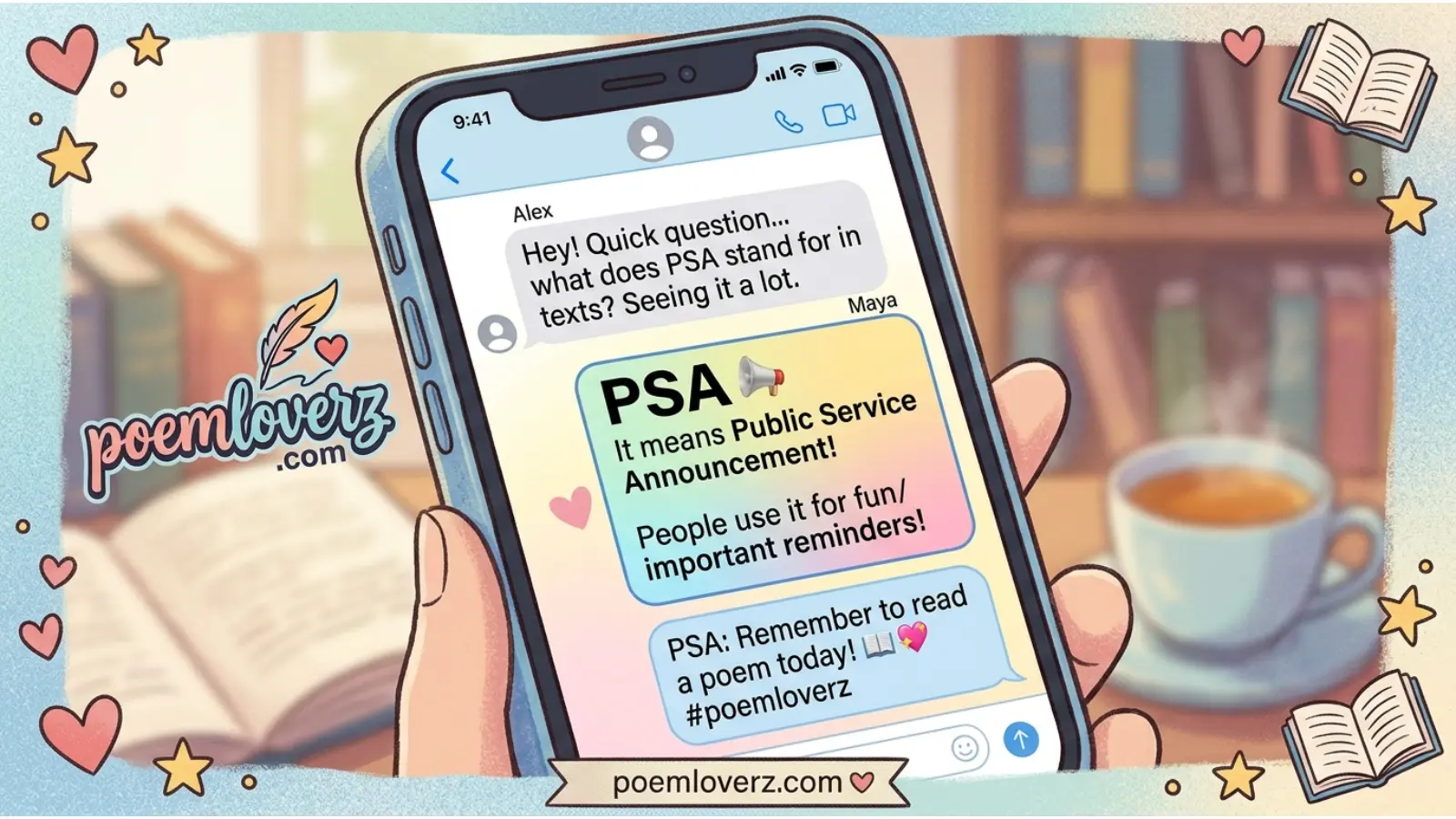
Have you ever received a message that simply said, “PSA: Don’t forget the meeting tomorrow,” or seen a TikTok comment that started with “PSA” and wondered what it actually meant?
Maybe a friend dropped a quick “PSA: He’s not worth your tears,” or someone posted, “PSA: This new coffee flavor is amazing.” At first glance, it can feel confusing because PSA appears in so many different conversations. Is it a warning? A joke? A helpful tip? Or something more emotional?
That confusion is exactly why so many people search for “psa mean in text.” The abbreviation shows up everywhere—from text messages and group chats to TikTok videos, Instagram captions, memes, and online discussions. Depending on the situation, it can sound serious, funny, caring, dramatic, or even sarcastic.
Modern internet slang is about more than words. It is about emotion, intention, and social connection. Understanding PSA helps you understand what people are really trying to communicate.
Let’s break it down in a way that actually makes sense.
PSA Mean in Text – Quick Definition
The most common meaning of PSA in text is:
PSA = Public Service Announcement
In texting and social media, PSA is used when someone wants to share information, advice, a warning, an opinion, or something they think others should know.
Examples:
Text Message
“PSA: Bring an umbrella today.”
Meaning: A friendly reminder or warning.
Instagram Story
“PSA: Drink more water.”
Meaning: Helpful advice.
TikTok Comment
“PSA: This movie will destroy your emotions.”
Meaning: A humorous recommendation or warning.
Group Chat
“PSA: The deadline is tomorrow.”
Meaning: Important information for everyone.
Depending on context, PSA can be used for:
- Noticing something important
- Giving advice
- Warning people
- Sharing opinions
- Joking with friends
- Calling attention to a problem
- Making playful announcements
- Expressing concern
At its core, PSA means:
“I think this is important enough that everyone should know.”
Origin & Background
The phrase “Public Service Announcement” existed long before texting and social media.
Traditionally, governments, television stations, schools, and public organizations used PSAs to share important information with the public. These announcements often focused on safety, health, education, or community awareness.
Over time, internet users borrowed the term and transformed it into everyday online language.
Instead of government warnings, people started using PSA for personal observations.
Examples:
“PSA: Don’t text your ex after midnight.”
“PSA: This restaurant is overrated.”
“PSA: Nobody looks good under fluorescent lighting.”
Social media accelerated this evolution.
Platforms like TikTok, Instagram, X, Reddit, and Facebook helped PSA become a humorous and relatable internet expression. What once sounded formal became casual, funny, and highly shareable.
Today, PSA often combines information with personality. It can be serious, sarcastic, emotional, caring, or comedic.
Online language evolves incredibly fast. Words that once belonged to official organizations can become internet slang overnight.
Real-Life Conversations
WhatsApp Chat
Friend 1:
“PSA: The teacher moved the exam to Friday.”
Friend 2:
“You’re a lifesaver.”
The PSA is functioning as a helpful announcement.
Instagram DM
Friend:
“PSA: Your latest photo is gorgeous.”
Friend:
“Stop, you’re too sweet.”
Here, PSA introduces a compliment.
TikTok Comment
“PSA: Watch this with tissues nearby.”
This serves as an emotional warning.
Text Message
“PSA: Traffic is horrible downtown.”
This acts as useful information.
Group Chat
“PSA: Nobody tell Sarah about the surprise party.”
This uses PSA in a playful way.
The emotional pattern is simple.
People use PSA when they want attention directed toward something they believe matters. Sometimes that importance is genuine. Sometimes it is exaggerated for humor. Either way, the speaker is saying:
“Pay attention for a second.”
Emotional & Psychological Meaning
PSA is surprisingly psychological.
When people use PSA, they are often trying to create awareness.
Sometimes they are protecting others.
Sometimes they are expressing care.
Sometimes they are sharing wisdom learned from experience.
And sometimes they are simply being dramatic for fun.
Consider this example:
A friend texts:
“PSA: Never grocery shop when you’re hungry.”
Everyone laughs.
But beneath the joke is a real experience and a small life lesson.
PSA allows people to communicate advice without sounding overly serious.
It softens authority.
It creates connection.
It says:
“I learned something, and I want to share it with you.”
In friendships, PSA can signal concern.
In relationships, it can show affection.
In online communities, it can build trust.
Imagine a coworker posting:
“PSA: Save your work before the system update.”
People appreciate the reminder because it protects them from a future problem.
That feeling of helping others is part of why PSA remains popular.
A personal example:
A friend once sent a group message saying:
“PSA: Don’t read online reviews before seeing the movie.”
Everyone laughed, but later admitted the advice was useful. The PSA wasn’t just information—it was social bonding through shared experience.
That’s the deeper psychology behind it.
Usage in Different Contexts
Social Media
On social media, PSA often introduces advice, opinions, warnings, recommendations, or humorous observations.
Examples:
“PSA: Sunscreen is not optional.”
“PSA: This song deserves more attention.”
“PSA: Sleep is underrated.”
The tone is usually friendly and engaging.
Friends & Relationships
Among friends, PSA often feels playful.
Examples:
“PSA: You’re better than that toxic relationship.”
“PSA: Stop apologizing for everything.”
The emotional tone can be supportive and caring.
Work or Professional Settings
In workplaces, PSA keeps its original informative purpose.
Examples:
“PSA: Team meeting starts at 9 AM.”
“PSA: Submit reports before Friday.”
Here, the tone is professional and practical.
Casual vs Serious Tone
Casual:
“PSA: Pizza fixes everything.”
Serious:
“PSA: Stay hydrated during the heat wave.”
The same abbreviation changes meaning depending on the topic and audience.
When NOT to Use It
While PSA is common online, it is not always appropriate.
Avoid using it when:
- Writing formal business documents
- Sending legal communications
- Discussing highly emotional conflicts
- Communicating with people unfamiliar with internet slang
- Speaking across cultural or language barriers
Some people may not understand the abbreviation and could miss the message entirely.
In sensitive conversations, clarity matters more than internet shorthand.
Context protects meaning.
Common Misunderstandings
PSA Always Means Government Announcements
Not anymore.
Most modern users employ PSA casually in daily conversation.
PSA Is Always Serious
False.
Many PSA messages are jokes or playful observations.
PSA Is Rude
Usually not.
Most PSA messages are intended to be helpful, informative, or humorous.
PSA Means the Same Thing Everywhere
Not exactly.
The core meaning remains similar, but tone varies based on platform, culture, and audience.
PSA Is Only for Social Media
No.
It appears in texts, emails, group chats, online communities, and workplace communication.
Comparison Table
| Expression | Meaning | Tone | Usage Context |
|---|---|---|---|
| PSA | Public Service Announcement | Helpful, informative, humorous | Texting, social media, work |
| FYI | For Your Information | Neutral | Professional and casual |
| BTW | By The Way | Casual | Everyday conversation |
| Heads Up | Warning or alert | Friendly | Friends and coworkers |
| Reminder | Important notice | Direct | Work and personal life |
| Note | Information point | Formal | Professional communication |
The emotional difference is that PSA often feels more attention-grabbing and slightly more dramatic than FYI or Reminder. It creates a sense that the information deserves special notice.
Variations & Types
Serious PSA
“PSA: Lock your doors at night.”
Focuses on safety or awareness.
Funny PSA
“PSA: Calories don’t count on weekends.”
Humorous and exaggerated.
Sarcastic PSA
“PSA: Ignoring emails doesn’t make them disappear.”
Uses irony.
Emotional PSA
“PSA: Be kinder to yourself.”
Supportive and compassionate.
Meme PSA
“PSA: My bank account hates me.”
Internet humor.
Exaggerated PSA
“PSA: This is literally the best burger ever.”
Adds dramatic emphasis.
Each variation changes the emotional tone while keeping the core announcement format.
How to Respond When Someone Uses It
Casual Replies
“Good to know.”
“Thanks for the heads-up.”
“I needed that reminder.”
Funny Replies
“PSA received.”
“Thank you for your public service.”
“I shall spread this wisdom.”
Mature Replies
“That’s actually helpful advice.”
“I appreciate you sharing that.”
“Very good point.”
Respectful Replies
“Thanks for letting everyone know.”
“That’s important information.”
“I completely agree.”
Socially, matching the other person’s energy often creates smoother communication.
Regional & Cultural Usage
Western Culture
In North America and Europe, PSA is widely recognized online and offline. Many people understand its original meaning and modern slang use.
Asian Culture
Younger internet users often recognize PSA through global social media platforms, although local slang may be more common.
Middle Eastern Culture
PSA appears mostly among English-speaking social media users and younger digital communities.
Global Internet Usage
TikTok, Instagram, YouTube, Reddit, and online gaming communities have made PSA a global expression.
Internet culture crosses borders quickly. A slang term can travel worldwide within days through memes, videos, and viral content.
Generational Differences
Gen Z
Gen Z frequently uses PSA in humorous, ironic, and meme-based ways.
Example:
“PSA: Being attractive won’t fix your homework.”
Millennials
Millennials often use PSA for practical advice and relatable observations.
Example:
“PSA: Back up your files.”
Older Generations
Older users are more likely to associate PSA with official announcements rather than internet humor.
Language often reflects identity. The way people use PSA can reveal how connected they are to online culture.
Is It Safe for Kids?
Generally, yes.
PSA is considered harmless internet slang.
However, children should still learn:
- Appropriate audience awareness
- Respectful communication
- Understanding sarcasm
- Responsible social media behavior
Most PSA messages involve advice, reminders, or humor rather than harmful content.
The biggest risk is misunderstanding tone, especially in online environments where context can be unclear.
Overall, PSA is one of the safer and more positive abbreviations used online today.
FAQs
What does PSA mean in text messages?
PSA most commonly means Public Service Announcement and is used to share information, advice, reminders, warnings, or opinions.
Is PSA rude?
No. PSA is usually helpful, informative, humorous, or supportive rather than rude.
What does PSA mean on TikTok?
On TikTok, PSA often introduces advice, recommendations, warnings, observations, or funny life lessons.
Why do people say PSA online?
People use PSA to draw attention to something they believe others should know.
Can PSA be used at work?
Yes. PSA is commonly used in workplace chats and emails for reminders or important announcements.
Do younger people use PSA differently?
Yes. Gen Z often uses PSA in a more humorous, sarcastic, and meme-inspired way compared to older generations.
Conclusion
So, what does psa mean in text?
The most common meaning is Public Service Announcement. In texting, social media, group chats, and online conversations, PSA is used to share information, advice, warnings, reminders, opinions, recommendations, and sometimes jokes.
What makes PSA interesting is that it is not just about information. It is about attention, connection, and shared experience. A simple three-letter abbreviation can communicate concern, humor, wisdom, support, or even playful internet drama.
As online communication continues to evolve, terms like PSA remind us that language is more than words. It is emotion, culture, identity, and human connection wrapped into a few characters on a screen.
Sometimes the smallest messages carry the biggest meaning—and PSA is a perfect example of that.