ash mean in text is something many people search for after seeing it in a message, social media post, or online chat and wondering what the sender actually meant. If you have come across this abbreviation and want a clear answer, you are in the right place.
The meaning of ash mean in text can change depending on the platform, the conversation, and the context in which it is used. That is why it can sometimes feel confusing, especially if you are texting with friends or browsing TikTok, Snapchat, or Instagram.
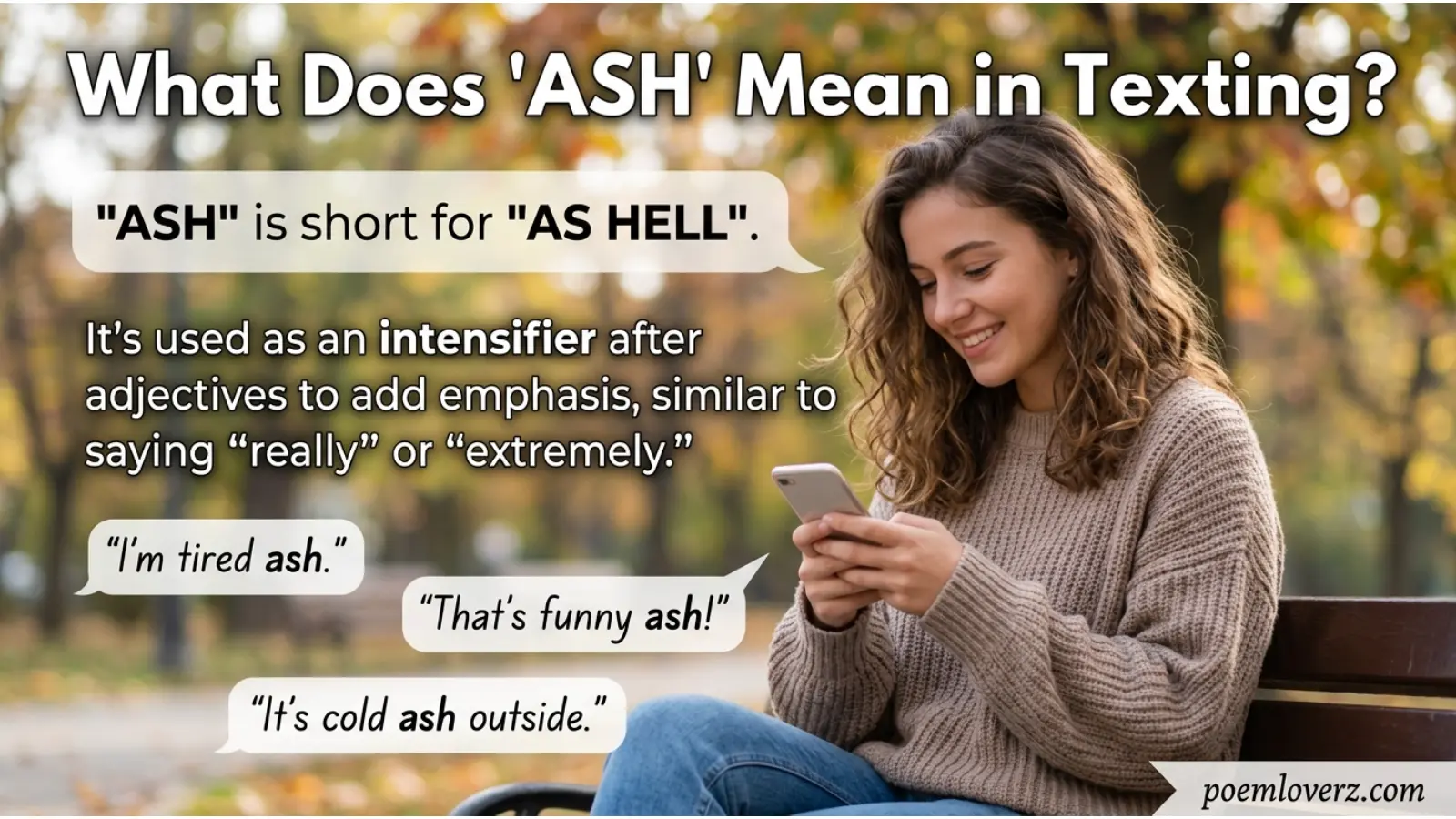
Most commonly, people use “ASH” as a shortened form of “as hell” to add emphasis, such as saying “I’m tired ash,” which means “I’m very tired.” However, ash mean in text may have other meanings in specific communities, games, or conversations, so understanding the context is important. Knowing these slang terms helps you avoid misunderstandings and stay updated with modern online language.
Quick Answer: In texting and social media, ASH most commonly means “as hell.” People use it to emphasize something, such as “funny ash” meaning “very funny.”
ash mean in text – Quick Definition
In texting, social media, and online conversations, ASH can have several meanings depending on context.
Common meanings of ASH include:
- As Hell (most popular slang meaning)
- A person’s name (Ash)
- Ashes or dust
- Acronym for Action on Smoking and Health
- Pokemon character Ash Ketchum reference
- Nickname or shortened form of Ashley
- Expression used for exaggeration
- Funny or playful emphasis
- Reaction to something shocking
- Complimenting or teasing someone
Examples:
“That movie was sad ash.”
Meaning:
Very sad.
“Bro, you’re funny ash 😂”
Meaning:
You’re extremely funny.
“I’m tired ash today.”
Meaning:
I’m very tired.
“Ash is coming over later.”
Meaning:
Someone named Ash is coming.
“That room dusty, covered in ash.”
Meaning:
Literal ashes or dust.
At its core, ASH usually means “as hell,” used to add emphasis, emotion, humor, or exaggeration.
Origin & Background
The slang meaning of ASH comes from shortening the phrase “as hell.”
Instead of typing:
- Funny as hell
- Tired as hell
- Cold as hell
People started shortening it online to:
- Funny ash
- Tired ash
- Cold ash
This style became popular in texting, African American Vernacular English (AAVE), memes, and social media communities. TikTok, Instagram, Snapchat, and Twitter helped spread it globally.
Teenagers and Gen Z users especially embraced the term because it sounds casual and expressive.
You’ll often hear:
- “Cute ash.”
- “Broke ash.”
- “Slow ash.”
- “Happy ash.”
Memes and short videos made the slang even more popular because internet culture loves turning everyday phrases into quicker forms.
Online language evolves incredibly fast. What sounds strange today may become normal tomorrow.
Real-Life Conversations
WhatsApp Chat
Friend 1: “You still awake?”
Friend 2: “Nah bro, I’m sleepy ash 😭”
Meaning:
“I’m extremely sleepy.”
Instagram DM
Her: “Your dog is cute ash!”
Meaning:
“Your dog is really cute.”
TikTok Comment
“These comments funny ash 😂”
Meaning:
“The comments are hilarious.”
Text Message
Mom: “How was work?”
Son: “Busy ash today.”
Meaning:
“It was extremely busy.”
Group Chat
Friend: “Bro got rejected again.”
Another friend: “That’s embarrassing ash 💀”
Meaning:
“That’s extremely embarrassing.”
Emotionally, people use “ash” to make statements feel stronger, funnier, or more relatable.
Emotional & Psychological Meaning
Slang isn’t just about words. It’s about feelings.
When someone says:
“Cute ash.”
They’re expressing admiration.
When they say:
“Slow ash.”
They’re teasing someone.
When they say:
“Tired ash.”
They’re sharing exhaustion in a lighthearted way.
Using “ash” often signals:
- Humor
- Confidence
- Casual personality
- Emotional exaggeration
- Social belonging
- Internet awareness
- Friendship and comfort
Imagine a group of coworkers chatting after a long day.
One friend says:
“I’m hungry ash.”
Everyone laughs because nobody literally means “as ashes.” Everyone understands the hidden emotion behind the phrase:
“I’m really hungry and trying to keep things light.”
Online slang creates emotional shortcuts. Instead of sounding serious, people sound relatable.
That’s the deeper psychology behind it.
Usage in Different Contexts
Social Media
TikTok and Instagram users often write:
- Pretty ash
- Funny ash
- Crazy ash
The tone is playful and expressive.
Example:
“That edit clean ash 🔥”
Meaning:
The video edit is extremely good.
Friends & Relationships
Friends use “ash” naturally.
Examples:
“I miss you ash.”
“I’m bored ash.”
“She’s cute ash.”
In relationships, it can even sound flirty.
Work or Professional Settings
Avoid using “ash” in professional emails or business conversations.
Instead of:
“I’m tired ash.”
Write:
“I’m exhausted today.”
Professional communication values clarity.
Casual vs Serious Tone
Casual:
“Cold ash outside.”
Serious:
“The weather is extremely cold.”
Context changes everything.
When NOT to Use It
Avoid using “ash” in:
- Job applications
- Business emails
- Academic papers
- Arguments
- Conversations with older audiences
- Cross-cultural situations where slang may confuse others
Example:
Wrong:
“Dear manager, I’m busy ash.”
Better:
“I’ve had an especially busy day.”
Slang works best when everyone understands it.
👉 Context protects meaning.
Common Misunderstandings
People Think It Means Actual Ashes
Not usually.
In texting, it most often means “as hell.”
People Think It’s Always Rude
Not true.
It’s often playful and harmless.
People Misread Tone
“Funny ash” is usually a compliment.
“Slow ash” might be teasing.
Context and relationship matter.
People Confuse It With Names
Ash is also a common name and nickname for Ashley.
Comparison Table
| Expression | Meaning | Tone | Usage Context |
|---|---|---|---|
| Ash | As hell | Casual | Texting, TikTok |
| AF | As f*** | Strong | Friends, memes |
| LOL | Laughing out loud | Funny | Texting |
| FR | For real | Serious or casual | Social media |
| TBH | To be honest | Honest | Conversations |
| OMG | Oh my God | Surprise | Messages |
| SMH | Shaking my head | Disappointed | Online comments |
Although these expressions may seem similar, each carries different emotional energy. “Ash” usually feels more playful and exaggerated.
Variations & Types
Playful Versions
- Funny ash
- Cute ash
- Happy ash
Sarcastic Versions
- Smart ash 🙄
- Slow ash
Emotional Versions
- Sad ash
- Lonely ash
- Stressed ash
Meme Variations
- Bro hungry ash.
- Sleepy ash.
- Rich ash.
Exaggerated Internet Forms
- Funny ashhh
- Cute ashhhh
- Tired ashhhh 😭
Adding extra letters increases emotional intensity.
How to Respond When Someone Uses It
Casual Replies
- “Same here.”
- “Facts.”
- “I know 😂”
Funny Replies
- “You dramatic ash.”
- “Stop lying 😂”
- “Bro relax.”
Mature Replies
- “Sounds like you’ve had a long day.”
- “Hope things get better.”
Respectful Replies
- “I understand.”
- “Thanks for telling me.”
Matching someone’s energy helps conversations feel natural.
Regional & Cultural Usage
Western Culture
In the United States and Canada, “ash” is commonly used as internet slang meaning “as hell.”
Asian Culture
Many Asian users learn the term through TikTok, gaming communities, and memes.
Middle Eastern Culture
Young social media users recognize “ash” because English slang spreads rapidly through Instagram and YouTube.
Global Internet Usage
Internet culture ignores borders.
Someone in Pakistan, Brazil, or the Philippines may understand “funny ash” thanks to TikTok trends and viral videos.
Social media has turned local slang into global language.
Generational Differences
Gen Z
Uses “ash” frequently.
Examples:
- Cute ash
- Broke ash
- Tired ash
For Gen Z, slang reflects identity and belonging.
Millennials
Understand the expression but may use AF instead.
Older Generations
Many older adults interpret “ash” literally and may not understand the slang meaning immediately.
Language often reveals the generation people grew up in.
Is It Safe for Kids?
Generally, yes.
“ASH” is usually harmless and used for emphasis.
However, kids should understand:
- Tone matters.
- Teasing can hurt feelings.
- Not everyone understands internet slang.
- Professional situations require different language.
Parents don’t usually need to worry about the term itself, but healthy communication and digital awareness are still important.
Frequently Asked Questions
What does ash mean in text?
Most commonly, ash means “as hell,” used to emphasize emotions or descriptions.
Is ash rude?
Not necessarily. It is generally casual and playful, though some people may find it informal.
What does funny ash mean?
It means something is extremely funny.
Why do people say ash on TikTok?
TikTok popularized the shortened version of “as hell,” making it part of everyday internet slang.
Can adults use ash?
Yes. Anyone can use it, but it is more common among younger generations.
Should I use ash at work?
No. Professional communication usually requires more formal language.
Conclusion
Understanding ash mean in text is about more than learning a trendy word. It’s about understanding how people express emotions, humor, exaggeration, and personality online.
The most common meaning of ASH is “as hell,” used to emphasize feelings or descriptions, such as “funny ash,” “cute ash,” or “tired ash.” However, it can also refer to a person’s name, ashes, Ashley, or other meanings depending on context.
Modern slang reflects how people connect emotionally. A simple word like “ash” can carry humor, affection, sarcasm, confidence, or relatability. That’s why internet language feels so alive—it captures emotions that traditional words sometimes miss.
In the end, words change, trends evolve, and meanings shift, but understanding the feelings behind them is what truly keeps us connected.