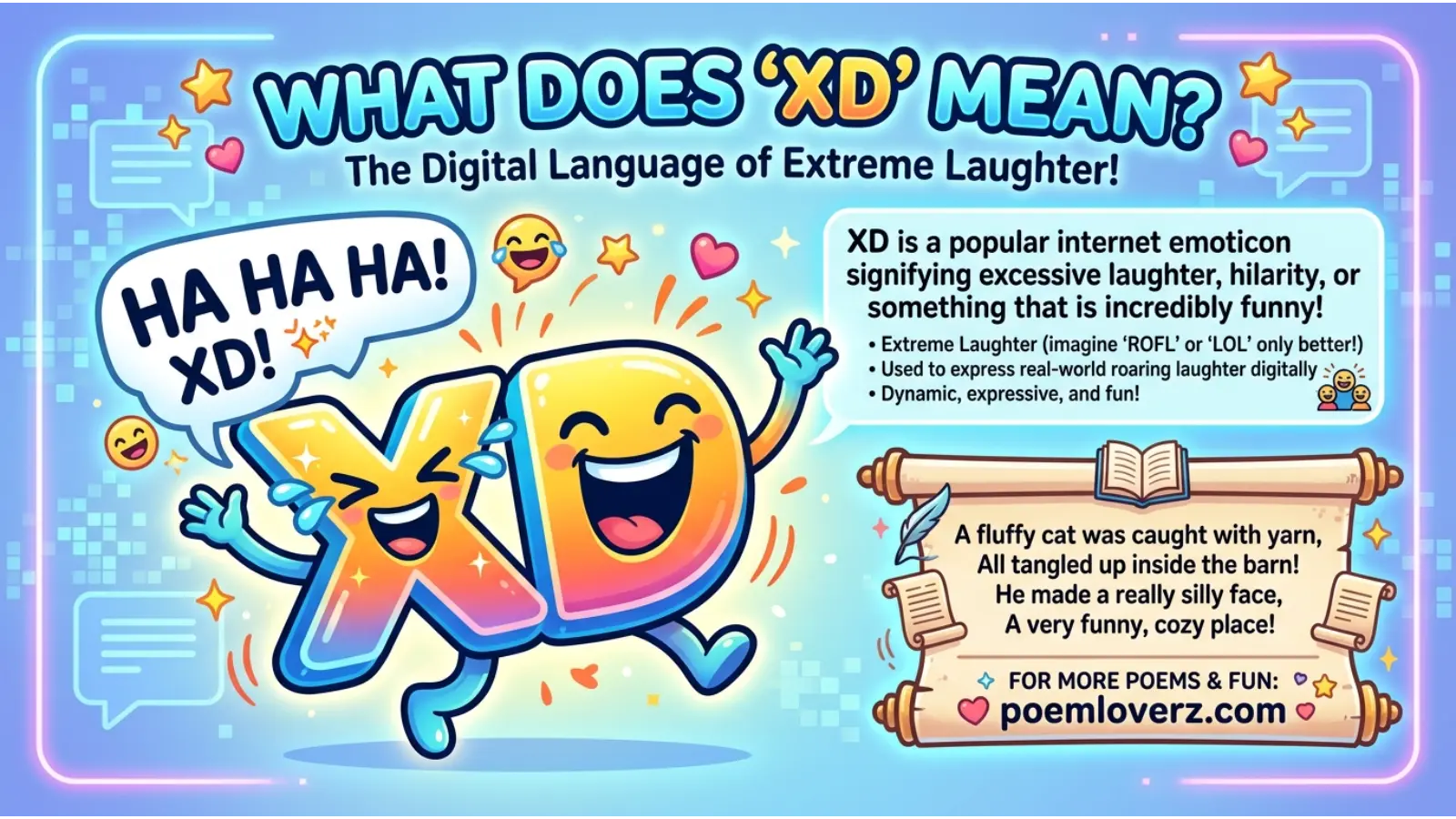
xd mean in text is one of those internet expressions that almost everyone has seen but not everyone fully understands. Imagine you’re chatting with a friend and they suddenly reply:
“That was the funniest thing I’ve seen all day XD”
Or maybe you scroll through a TikTok comment section and find dozens of people ending their comments with XD.
At first glance, it can look confusing. Is it a word? An abbreviation? A secret internet code? Is someone laughing, being sarcastic, flirting, or making fun of something?
These are exactly the reasons people search for the meaning of XD. The expression has been around for years, yet it continues to appear across texts, gaming chats, social media platforms, memes, and online communities.
What makes XD interesting isn’t just its definition. It’s the emotion behind it. It tells people how someone feels without needing a full sentence.
Let’s break it down in a way that actually makes sense.
XD Mean in Text – Quick Definition
The most common meaning of XD in text is:
A laughing face used to show extreme amusement, laughter, excitement, or playful emotion.
When viewed sideways:
X = Closed eyes from laughing
D = A wide open smiling mouth
Together, XD looks like a person laughing very hard.
Main Meanings of XD
Laughing
Used when something is genuinely funny.
Example:
“You slipped on your own shoelace XD”
Joking
Shows playful humor.
Example:
“I totally forgot your birthday XD”
Reacting
Expresses surprise mixed with amusement.
Example:
“You actually did that? XD”
Teasing
Lightheartedly pokes fun at someone.
Example:
“Nice parking skills XD”
Flirting
Sometimes used to make messages feel more playful.
Example:
“Maybe I missed you a little XD”
Complimenting
Can soften praise and make it feel friendly.
Example:
“You’re way too talented XD”
Sarcasm
Occasionally used to indicate joking sarcasm.
Example:
“Best idea ever… XD”
Emotional Expression
Shows happiness, excitement, or positive energy.
Example:
“I got the job XD”
At its core, XD usually communicates:
“I’m laughing, amused, playful, or emotionally enjoying this moment.”
Origin & Background
The history of XD goes back to the early internet era.
Before emojis existed, people used keyboard characters to create emotional expressions called emoticons.
Some famous examples included:
🙂 = Happy
🙁 = Sad
😛 = Sticking out tongue
😉 = Wink
XD quickly became popular because it represented stronger laughter than a simple smile.
Internet forums, chat rooms, online gaming communities, and messaging platforms helped spread the expression throughout the late 1990s and early 2000s.
As social media grew, XD followed.
It appeared on:
- MSN Messenger
- Yahoo Messenger
- MySpace
- Online gaming chats
- Reddit communities
- TikTok comments
- Instagram conversations
Meme culture also played a major role. People started using XD to exaggerate reactions and create humorous online personalities.
Today, while emojis dominate digital communication, XD still survives because it carries a nostalgic internet vibe.
Online language changes incredibly fast, and XD is proof that some internet expressions become cultural symbols rather than temporary trends.
Real-Life Conversations
WhatsApp Chat
Friend 1:
“I accidentally sent the screenshot to the person I was talking about.”
Friend 2:
“NO WAY XD”
Instagram DM
Person A:
“I spent twenty minutes looking for my phone.”
Person B:
“While holding it? XD”
TikTok Comment
“This dog has more confidence than me XD”
Text Message
Friend:
“I walked into the wrong classroom.”
Reply:
“That’s so you XD”
Group Chat
Friend:
“Guys, I burned instant noodles.”
Group:
“How is that even possible XD”
Emotional Pattern Behind These Examples
Notice something?
People rarely use XD during serious conversations.
Instead, it appears when users want to:
- Reduce awkwardness
- Increase friendliness
- Show amusement
- Create emotional warmth
- Signal playful intent
It acts like a social cushion that keeps conversations light.
Emotional & Psychological Meaning
The psychology behind XD is surprisingly interesting.
People don’t just use XD because they’re laughing.
They use it because they want others to feel their laughter.
In face-to-face communication, people can see smiles, hear tone of voice, and notice body language.
Texting removes those signals.
XD fills that gap.
It tells others:
- I’m joking.
- I’m not attacking you.
- I’m having fun.
- I’m enjoying this interaction.
Sometimes XD also acts as emotional protection.
Imagine texting:
“You’re weird.”
That can sound rude.
Now compare it with:
“You’re weird XD”
Suddenly it feels playful.
The emotional energy changes completely.
A small symbol changes the social meaning.
A Mini Story
A coworker once sent a message saying:
“I accidentally emailed the wrong file XD”
Everyone knew the mistake was real.
But the XD communicated something important:
“Yes, I messed up, but let’s not panic.”
The expression softened embarrassment and encouraged connection instead of criticism.
That’s the deeper psychology behind it.
Usage in Different Contexts
Social Media
On TikTok, Instagram, and gaming platforms, XD often shows amusement or meme appreciation.
Example:
“This video gets funnier every time XD”
Friends & Relationships
Friends commonly use XD to create playful conversations.
Example:
“You really thought that would work XD”
In relationships, it can make messages feel warmer and more flirtatious.
Example:
“Maybe I was waiting for your text XD”
Work or Professional Settings
Generally, XD is not recommended in professional communication.
Example:
“The report is delayed XD”
This can appear unprofessional or dismissive.
Casual vs Serious Tone
Casual:
“I forgot my keys again XD”
Serious:
“I’m sorry for what happened.”
In emotional discussions, XD can seem insensitive.
Context changes everything.
When NOT to Use It
Avoid using XD in:
- Business emails
- Professional reports
- Customer service communication
- Serious arguments
- Emotional conflicts
- Formal presentations
- Academic writing
- Conversations with people unfamiliar with internet slang
Older audiences may not understand the expression.
International audiences may interpret it differently.
When emotions are already sensitive, adding XD can make you appear dismissive.
Context protects meaning.
Common Misunderstandings
Misunderstanding 1: XD Is a Word
No.
XD is an emoticon representing a laughing face.
Misunderstanding 2: XD Is Always Rude
Not true.
Most uses are friendly and humorous.
Misunderstanding 3: XD Means the Same as LOL
Not exactly.
LOL describes laughter.
XD visually represents laughter.
Misunderstanding 4: Everyone Uses It the Same Way
Different communities attach different emotional meanings.
Misunderstanding 5: XD Is Only for Teenagers
While popular among younger users, many Millennials still use it regularly.
Comparison Table
| Expression | Meaning | Tone | Usage Context |
|---|---|---|---|
| XD | Strong laughter or amusement | Playful | Texting, gaming, social media |
| LOL | Laughing out loud | Casual | Everyday conversations |
| LMAO | Intense laughter | Energetic | Informal chats |
| 😂 | Crying with laughter | Modern | Most social platforms |
| 😆 | Excited laughter | Friendly | Social media and texting |
| ROFL | Rolling on the floor laughing | Exaggerated | Internet humor |
| Haha | Natural laughter | Neutral | Universal use |
The biggest difference is emotional style.
XD feels more internet-native, nostalgic, and expressive than many modern alternatives.
Variations & Types
xD
A common lowercase variation.
XDD
Extra laughter.
The additional D exaggerates the reaction.
XDDD
Extreme internet laughter.
Often used in gaming communities.
XD?
Playful confusion.
Example:
“You actually did that XD?”
XD!!!
Excited amusement.
ironic XD
Used sarcastically in memes.
nostalgic XD
Often used by older internet users who grew up with forums and early social media.
Each variation slightly changes the emotional intensity.
How to Respond When Someone Uses It
Casual Replies
- Haha true.
- That’s funny.
- You’re right.
- I can’t stop laughing.
Funny Replies
- Stop exposing me XD.
- I wasn’t ready for that.
- You’re evil XD.
- Why are you like this?
Mature Replies
- I see what you mean.
- That’s actually a good point.
- Fair enough.
Respectful Replies
- Thanks for sharing.
- I appreciate that.
- Good observation.
Matching the other person’s energy often creates smoother conversations.
Regional & Cultural Usage
Western Culture
XD became highly popular through forums, gaming communities, and early social networking sites.
Asian Culture
Many users recognize XD because of anime communities, gaming culture, and online messaging platforms.
Middle Eastern Culture
XD appears frequently among younger social media users and gaming communities.
Global Internet Usage
The internet has created a shared digital language.
Someone in Pakistan, Japan, Germany, Brazil, or the United States can instantly recognize XD.
Social media spreads slang across borders faster than ever before.
Generational Differences
Gen Z
Often prefers emojis like 😂 or 💀 but still understands XD.
Millennials
Many Millennials actively use XD because they grew up during its peak popularity.
Older Generations
Some may recognize it, while others find it confusing.
Language has always reflected identity.
Online language simply makes those identity signals more visible.
Is It Safe for Kids?
Generally, yes.
XD is considered harmless internet slang.
It usually communicates:
- Happiness
- Laughter
- Playfulness
- Friendly teasing
However, like any expression, tone matters.
If used during bullying or mockery, the emotional impact can change.
Parents should focus more on conversation context than the symbol itself.
In most situations, XD is simply a digital laugh.
FAQs
What does XD mean in text messages?
XD means a laughing face emoticon that expresses amusement, humor, excitement, or playful emotion.
Is XD rude?
Usually no. Most people use XD in a friendly and humorous way.
What does XD mean on TikTok?
On TikTok, XD typically signals laughter, entertainment, meme appreciation, or playful reactions.
Is XD the same as LOL?
Not exactly. LOL means “laughing out loud,” while XD visually represents a laughing face.
Do people still use XD?
Yes. Although emojis are more common today, many internet users still use XD for nostalgic or stylistic reasons.
Can XD be used at work?
Generally, it is best avoided in professional communication because it may seem informal or unprofessional.
Conclusion
The meaning of XD in text is simple on the surface but surprisingly rich underneath. Literally, XD means a laughing face emoticon with closed eyes and a wide-open smiling mouth, expressing strong laughter, amusement, joy, excitement, teasing, joking, playful flirting, or lighthearted emotional reactions.
What makes XD special is not just the symbol itself. It’s the emotion it carries. It helps people show humor, soften conversations, build connection, and add personality to plain text.
In a world where most communication happens through screens, small expressions like XD become emotional shortcuts. They help us share feelings that words alone sometimes struggle to capture.
Internet culture continues to evolve, but XD remains a reminder that even two simple characters can communicate a surprisingly human emotion.