SMH Mean in Text is a common question people ask after seeing the abbreviation in text messages, social media comments, memes, or online chats. If you’ve come across someone replying with “SMH” and wondered what they meant, you’re in the right place.
This short expression is widely used across platforms like Instagram, TikTok, Snapchat, Facebook, X, and messaging apps, making it an important piece of modern internet slang to understand.
People often search for SMH Mean in Text because the meaning isn’t always obvious at first glance. While the abbreviation usually carries a specific emotion, the exact interpretation can vary depending on the conversation, platform, tone, and context in which it’s used.
In some cases, it expresses disappointment, while in others it may show disbelief, frustration, embarrassment, or annoyance. Understanding how and when people use SMH can help you follow online conversations more naturally and avoid misunderstandings when chatting with friends or interacting on social media.
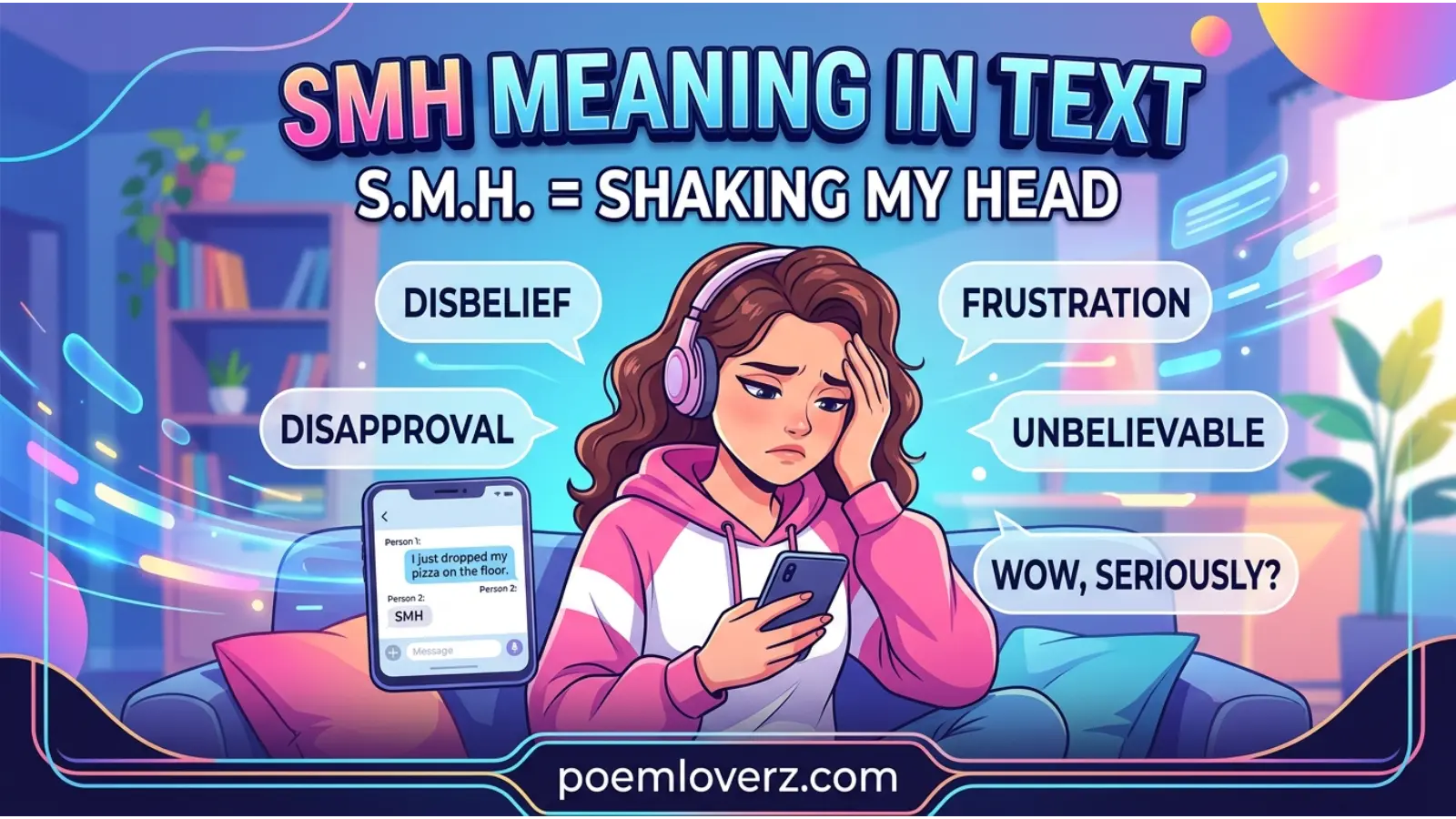
Quick Answer: SMH most commonly stands for “Shaking My Head.” It is used in texting and online conversations to show disappointment, disbelief, frustration, or disapproval about something someone said or did.
SMH – Quick Definition
SMH stands for:
Shaking My Head
The phrase is used when someone reacts to something they find:
- Disappointing
- Silly
- Ridiculous
- Embarrassing
- Unbelievable
- Frustrating
- Funny in a disappointing way
Main Meanings of SMH in Text
Shaking My Head
The most common meaning.
Example:
“You forgot the tickets again? SMH.”
Meaning:
“I’m disappointed and can’t believe you did that.”
Disbelief
Example:
“He spent $500 on virtual shoes. SMH.”
Meaning:
“That’s hard to believe.”
Mild Criticism
Example:
“You skipped class to sleep? SMH.”
Meaning:
“That wasn’t a smart decision.”
Playful Teasing
Example:
“You still don’t know how to use emojis? SMH 😂”
Meaning:
“I’m jokingly making fun of you.”
Frustration
Example:
“The internet stopped working during my meeting. SMH.”
Meaning:
“I’m annoyed.”
Humorous Reaction
Example:
“My dog stole my sandwich again. SMH.”
Meaning:
“This is ridiculous but kind of funny.”
At its core, SMH is an emotional reaction that communicates disappointment, disbelief, frustration, or amused judgment without writing a long explanation.
Origin & Background
The phrase “Shaking My Head” existed long before the internet.
People have physically shaken their heads for centuries to express disagreement, disappointment, confusion, or disbelief. As texting culture evolved, internet users began turning common expressions into abbreviations.
Just like:
- LOL = Laughing Out Loud
- OMG = Oh My God
- BRB = Be Right Back
“Shaking My Head” became SMH.
The term became popular in early online forums, chat rooms, and texting communities. As social media exploded, SMH spread rapidly across platforms.
Meme culture played a huge role.
People started pairing SMH with:
- funny videos
- embarrassing moments
- celebrity mistakes
- viral fails
- awkward situations
Then came TikTok.
TikTok’s reaction-based culture made SMH even more common because users constantly respond to strange, funny, or unbelievable content.
Today, SMH has become part of everyday digital language across the world.
One interesting thing about internet language is that it evolves faster than traditional language ever did. A phrase can go from a niche abbreviation to a global expression in just a few years.
Real-Life Conversations
WhatsApp Chat
Friend 1:
“I forgot my wallet at home.”
Friend 2:
“SMH. You always do this.”
Instagram DM
Person A:
“I accidentally liked a photo from 2018.”
Person B:
“SMH that’s every Instagram user’s nightmare.”
TikTok Comment
Video:
Someone tries a dangerous challenge and instantly fails.
Comment:
“SMH why would anyone think that was a good idea?”
Text Message
Friend:
“I overslept and missed my flight.”
Reply:
“SMH 😭”
Group Chat
Person:
“I studied the wrong chapter for the exam.”
Group:
“SMH.”
Emotional Pattern Behind SMH
Most people use SMH when they experience a mix of:
- surprise
- disappointment
- amusement
- disbelief
It’s often less aggressive than direct criticism and more expressive than simply saying “wow.”
Emotional & Psychological Meaning
SMH is fascinating because it communicates emotion without directly naming it.
When people use SMH, they’re often saying:
“I noticed this.”
“I can’t believe this happened.”
“You should probably know this wasn’t your best moment.”
Sometimes it’s disappointment.
Sometimes it’s sarcasm.
Sometimes it’s affection hidden inside teasing.
For example, imagine a friend who constantly loses their keys.
Every week:
“I lost them again.”
Your response:
“SMH 😂”
You aren’t truly angry.
You’re expressing familiarity, humor, and mild frustration all at once.
Psychologically, SMH often functions as social correction. It allows people to point out mistakes without launching into a serious lecture.
It can also protect emotions.
Instead of saying:
“I’m frustrated with you.”
Someone simply writes:
“SMH.”
The message feels lighter.
In dating culture, SMH can even signal playful attraction.
Example:
“You really forgot our movie time? SMH.”
Depending on context, the person may actually be flirting while pretending to complain.
That’s the deeper psychology behind it.
Usage in Different Contexts
Social Media
On social media, SMH is often used as a reaction.
Example:
“People still believe that rumor? SMH.”
The tone is usually judgmental, surprised, or sarcastic.
Friends & Relationships
Among friends, SMH is often playful.
Example:
“You ordered pineapple pizza again? SMH 😂”
The phrase becomes friendly teasing rather than criticism.
Work or Professional Settings
Professional environments generally avoid SMH.
Example:
“SMH at this report.”
This can appear unprofessional and disrespectful.
A better option would be:
“I believe this report needs revisions.”
Casual vs Serious Tone
Casual:
“You forgot your charger? SMH 😂”
Serious:
“People spreading misinformation online. SMH.”
The same abbreviation can feel lighthearted or critical depending on context.
When NOT to Use It
Avoid using SMH in:
- Formal emails
- Business meetings
- Academic writing
- Professional communication
- Serious emotional arguments
- Conversations with people unfamiliar with internet slang
- Cross-cultural situations where slang may be misunderstood
Some people may interpret SMH as rude, dismissive, or passive-aggressive.
Context protects meaning.
Common Misunderstandings
“SMH Means Angry”
Not always.
Many people use it jokingly.
“SMH Is Always Rude”
False.
Friends often use it affectionately.
“SMH Only Means Disappointment”
Not necessarily.
It can also express amusement, disbelief, or sarcasm.
“SMH Is Used Only by Teenagers”
Incorrect.
Many Millennials and adults use it regularly.
“SMH Has One Fixed Meaning”
Internet slang rarely works that way.
Context changes everything.
Comparison Table
| Expression | Meaning | Tone | Usage Context |
|---|---|---|---|
| SMH | Shaking My Head | Disappointed, sarcastic | Mistakes, silly actions |
| LOL | Laughing Out Loud | Humorous | Funny situations |
| OMG | Oh My God | Shocked, excited | Surprising events |
| Facepalm | Embarrassment or disbelief | Frustrated | Obvious mistakes |
| BRUH | Seriously? | Playful disbelief | Friends and memes |
| Sigh | Frustration or tiredness | Emotional | Annoying situations |
The biggest difference is that SMH combines disappointment and disbelief into a quick emotional reaction, making it uniquely expressive.
Variations & Types
SMHH
Shaking My Head Harder
Used for extra disappointment.
Example:
“You forgot again? SMHH.”
SMFH
Shaking My Freaking Head
A stronger and more emotional version.
Example:
“They canceled the event at the last minute. SMFH.”
SMH 😂
Adds humor.
Example:
“You walked into the wrong classroom. SMH 😂”
SMH My Head
A meme variation.
Technically redundant because SMH already means “Shaking My Head.”
People use it ironically.
SMH Bro
Adds direct frustration toward someone.
Example:
“SMH bro, what were you thinking?”
Each variation slightly changes the emotional intensity.
How to Respond When Someone Uses It
Casual Replies
- “I know, right?”
- “My bad.”
- “Fair enough.”
- “You’re not wrong.”
Funny Replies
- “I’m trying my best.”
- “Leave me alone 😂”
- “Character development.”
- “It builds personality.”
Mature Replies
- “You’re right. I’ll fix it.”
- “Good point.”
- “I should have handled that better.”
Respectful Replies
- “Thanks for pointing it out.”
- “I understand your perspective.”
- “I’ll keep that in mind.”
Matching the other person’s energy often creates the smoothest conversation.
Regional & Cultural Usage
Western Culture
In North America and Europe, SMH is extremely common in texting and social media.
It often expresses sarcasm and disbelief.
Asian Culture
Many younger internet users recognize SMH through global social platforms, especially TikTok and gaming communities.
Middle Eastern Culture
English-speaking social media users frequently use SMH alongside local languages and expressions.
Global Internet Usage
The internet has created a shared slang culture.
Someone in Pakistan, Canada, the UK, Australia, or the Philippines can understand SMH instantly even if they speak different native languages.
Social media continues to erase language barriers through shared internet expressions.
Generational Differences
Gen Z
Uses SMH naturally in:
- TikTok comments
- Snapchat messages
- memes
- gaming chats
Often paired with emojis.
Millennials
Use SMH frequently in texting and social media.
Many helped popularize it during the early social media era.
Older Generations
May recognize the term but use it less often.
Some still prefer writing the full reaction instead.
Language often reflects identity, and internet slang helps generations signal membership in digital culture.
Is It Safe for Kids?
Generally, yes.
SMH is considered a harmless internet abbreviation.
However, parents should understand that:
- it can sometimes be used mockingly
- it may carry sarcasm
- repeated use can become teasing
Most of the time, children use SMH simply to express surprise, disappointment, or amusement.
Like any slang, the surrounding conversation matters more than the abbreviation itself.
FAQs
What does SMH mean in text?
SMH means Shaking My Head, usually expressing disappointment, disbelief, frustration, or amusement.
Is SMH rude?
Not necessarily. It can be playful, sarcastic, or mildly critical depending on context.
What does SMH mean on TikTok?
On TikTok, SMH is commonly used as a reaction to funny, ridiculous, embarrassing, or unbelievable videos.
Can I use SMH in professional communication?
It’s usually best to avoid SMH in formal workplace communication.
Do adults use SMH?
Yes. Teenagers, Millennials, and many adults regularly use SMH online.
Why is SMH so popular?
Because it quickly communicates emotion without requiring a long explanation.
Conclusion
So, SMH mean in text refers to “Shaking My Head,” an internet slang expression used to show disappointment, disbelief, frustration, embarrassment, mild criticism, sarcasm, or amused judgment.
What makes SMH powerful is not the abbreviation itself but the emotion packed inside it. In a world where people communicate through quick messages, comments, memes, and reactions, SMH acts like a digital facial expression. It tells others exactly how you feel without writing a paragraph.
Whether it’s reacting to a friend’s funny mistake, a viral TikTok fail, an unbelievable news story, or an awkward social moment, SMH helps people express that unique feeling of “I can’t believe this just happened.”
Modern slang continues to evolve because people constantly look for faster, more emotional ways to connect. SMH is one of the clearest examples of how internet culture transforms simple reactions into shared language.
The next time you see SMH, remember its core meaning: Shaking My Head — a quick expression of disappointment, disbelief, frustration, or amused judgment. Sometimes three small letters say more than an entire sentence ever could.