STFU Mean in Text is a phrase many people search for after seeing it in a text message, social media comment, gaming chat, or online conversation and wondering what it actually means.
If someone recently sent you “STFU” and you were unsure If it was a joke, a friendly tease, or something rude, you’re not alone. Internet slang moves fast, and understanding these abbreviations can help you avoid confusion and respond appropriately.
The meaning of STFU can change depending on the situation, the relationship between the people talking, and the platform where it is used.
In some conversations, it may be used aggressively, while in others it can be playful or sarcastic among friends. Because context matters, it’s important to look at the tone of the message before deciding how to interpret it. This guide explains STFU Mean in Text, where it comes from, how people use it online, and what it means in different digital conversations.
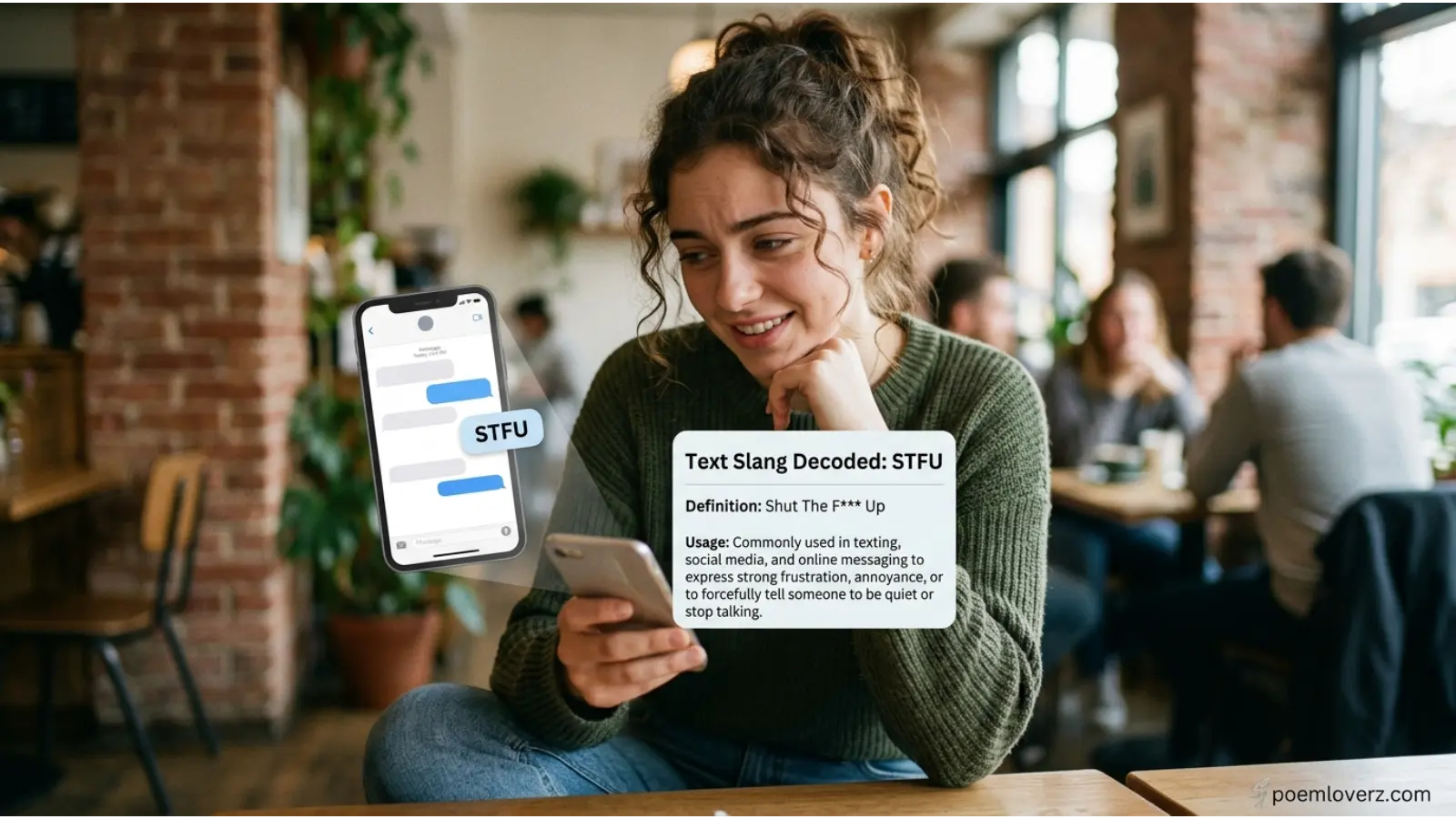
Quick Answer: STFU most commonly stands for “Shut The F*** Up.” In texting, social media, and gaming chats, it is usually used to tell someone to stop talking, though the tone can range from joking and playful to rude or confrontational depending on the context.
STFU Mean in Text – Quick Definition
STFU stands for:
“Shut The F* Up.”**
The literal meaning is a direct command telling someone to stop talking.
However, in modern texting and social media culture, STFU can have several different meanings depending on the situation.
Possible meanings include:
- Telling someone to be quiet
- Expressing shock
- Reacting to surprising news
- Showing excitement
- Playful teasing
- Friendly joking
- Expressing disbelief
- Responding to gossip
- Highlighting something unbelievable
- Showing amusement
Examples
Friend: “I just won free concert tickets.”
Reply: “STFU! No way!”
Meaning: “I can’t believe it.”
Friend: “I accidentally sent my boss a meme.”
Reply: “STFU 😂”
Meaning: “That’s hilarious.”
Argument:
“STFU and listen.”
Meaning: Literal command to stop talking.
At its core, STFU often communicates a strong emotional reaction rather than a simple instruction.
Origin and Background
STFU existed long before TikTok and Instagram.
The phrase originated as a shortened internet version of the expression “Shut The F*** Up.” Early internet users frequently abbreviated long phrases to save typing time in chat rooms, gaming forums, and messaging platforms.
During the late 1990s and early 2000s, STFU became common in:
- Online gaming
- Internet forums
- AOL chats
- Message boards
- Early social media communities
Initially, the term was mostly aggressive.
As internet culture evolved, people began using it humorously.
Then came meme culture.
Platforms like TikTok, Instagram, Snapchat, and Twitter transformed STFU into a reaction phrase. Instead of expressing anger, many users started using it to express:
- Surprise
- Excitement
- Disbelief
- Entertainment
Today, a person saying “STFU” may actually be laughing, smiling, or completely amazed.
That’s one of the fascinating realities of internet language—meanings evolve faster than dictionaries can keep up.
Real-Life Conversations
WhatsApp Chat
Friend: “I met my celebrity crush today.”
You: “STFU! Seriously?”
Meaning: Shock and excitement.
Instagram DM
Friend: “Guess who followed me back?”
You: “STFU 😭”
Meaning: Excited disbelief.
TikTok Comment
Creator: “I found $500 inside an old jacket.”
Comment: “STFU that’s insane.”
Meaning: Amazement.
Text Message
Friend: “I got accepted into my dream university.”
Reply: “STFU OMG congratulations!”
Meaning: Excited reaction.
Group Chat
Friend: “I accidentally texted my ex.”
Everyone: “STFU 😂😂😂”
Meaning: Humorous reaction.
Across these examples, the emotional pattern is clear.
People often use STFU when emotions become stronger than ordinary words.
Emotional and Psychological Meaning
This is where things get interesting.
Most people don’t use STFU because they literally want someone to stop talking.
Instead, they use it because they’re experiencing an emotional spike.
Surprise
Unexpected information often triggers STFU.
“STFU, are you serious?”
The brain struggles to process surprising information quickly.
Humor
Friends frequently use STFU when something is extremely funny.
The phrase becomes an exaggerated emotional reaction.
Social Bonding
Among close friends, playful insults can actually strengthen connections.
The relationship creates safety, making the phrase feel humorous rather than offensive.
Confidence
Some people use STFU to project boldness or confidence online.
It creates a casual, unfiltered personality.
Emotional Protection
Humans often hide excitement behind humor.
Instead of saying:
“I’m incredibly excited for you.”
Someone might simply say:
“STFU that’s amazing.”
A Mini Story
Imagine a friend tells you they’ve just gotten engaged.
You stare at your phone.
Your eyes widen.
You smile.
Your first response?
“STFU!!”
You aren’t angry.
You’re overwhelmed by surprise and happiness.
That’s the deeper psychology behind it.
Usage in Different Contexts
Social Media
On TikTok, Instagram, and X, STFU often signals surprise, excitement, or disbelief.
Example:
“STFU this outfit is gorgeous.”
The meaning is positive.
Friends and Relationships
Close friends commonly use STFU playfully.
Example:
“STFU, you’re lying.”
Tone matters more than words.
Work or Professional Settings
Avoid using STFU in professional communication.
Emails, meetings, and workplace chats require more respectful language.
Casual vs Serious Tone
Casual:
“STFU that’s hilarious.”
Serious:
“STFU and listen.”
The same acronym can sound playful or hostile depending on context.
When NOT to Use It
Avoid STFU in:
- Professional emails
- Workplace communication
- Customer service interactions
- Academic settings
- Formal conversations
- Serious emotional discussions
- Conversations with people unfamiliar with slang
- Cross-cultural communication
Because STFU contains profanity, some people may view it as disrespectful regardless of intent.
Context protects meaning.
Common Misunderstandings
Misunderstanding 1: STFU Is Always Rude
Not necessarily.
Among friends, it is often playful.
Misunderstanding 2: STFU Always Means Anger
Many people use it while laughing.
Misunderstanding 3: Everyone Understands the Joke
Different audiences interpret slang differently.
Misunderstanding 4: Online Meaning Equals Real-Life Meaning
Internet culture often softens expressions that would sound harsh offline.
Comparison Table
| Expression | Meaning | Tone | Usage Context |
|---|---|---|---|
| STFU | Shut The F*** Up | Shock, humor, anger | Friends, social media |
| OMG | Oh My God | Surprise | General texting |
| WTF | What The F*** | Confusion, shock | Casual conversations |
| NO WAY | Disbelief | Positive surprise | Universal |
| BRUH | Reaction to something absurd | Humor | Social media |
| SMH | Shaking My Head | Disappointment | Texting and online discussions |
The biggest difference is emotional intensity.
STFU often delivers a stronger emotional reaction than most alternatives.
Variations and Types
STFUUU
Extra letters increase emotional intensity.
“STFUUUU that’s crazy!”
STFU LOL
Adds humor.
STFU OMG
Combines shock and excitement.
STFU PLEASE
Usually playful disbelief.
STFU RIGHT NOW
Dramatic reaction often used in memes.
STFU 😭
Common on TikTok and Instagram.
Signals emotional overwhelm rather than anger.
Each variation subtly changes the emotional flavor.
How to Respond When Someone Uses It
Casual Replies
- “I know, right?”
- “Crazy, isn’t it?”
- “I’m still shocked too.”
Funny Replies
- “I’m physically unable to STFU.”
- “Never.”
- “The drama continues.”
Mature Replies
- “Seriously though, it’s true.”
- “I couldn’t believe it either.”
Respectful Replies
- “Haha, I know.”
- “Glad you liked the news.”
Successful communication often comes from matching the other person’s energy.
Regional and Cultural Usage
Western Culture
STFU is widely understood and commonly used among younger internet users.
Asian Culture
Usage exists primarily through social media exposure and English-speaking online communities.
Middle Eastern Culture
Many users recognize STFU through gaming, memes, and global social media.
Global Internet Usage
TikTok, Instagram, YouTube, Discord, and gaming communities have made STFU a globally recognized slang term.
Internet culture increasingly creates shared language across countries.
Generational Differences
Gen Z
Uses STFU frequently as a humorous reaction.
Example:
“STFU that’s so cute.”
Millennials
Understand both the original aggressive meaning and the newer playful usage.
Older Generations
More likely to interpret STFU literally and view it as rude.
Language often reflects digital identity, cultural exposure, and online habits.
Is It Safe for Kids?
The answer depends on context.
STFU contains profanity and can be considered offensive.
Potential concerns include:
- Encouraging disrespectful communication
- Normalizing profanity
- Misunderstanding social boundaries
However, many young people use it casually without intending harm.
Parents and educators should focus on teaching context, audience awareness, and respectful communication.
Understanding slang is important, but understanding when to use it is even more important.
Frequently Asked Questions
What does STFU mean in text?
STFU means “Shut The F*** Up.” It can express surprise, disbelief, humor, excitement, or anger depending on context.
Is STFU rude?
It can be. However, among close friends it is often used playfully rather than aggressively.
What does STFU mean on TikTok?
On TikTok, STFU commonly expresses shock, excitement, amusement, or disbelief.
Why do friends say STFU to each other?
Friends often use it humorously to react to surprising, funny, or unbelievable situations.
Can STFU be used at work?
No. Because it contains profanity, it is generally inappropriate in professional environments.
Do younger generations use STFU differently?
Yes. Gen Z frequently uses STFU as a reaction phrase rather than a literal command.
Conclusion
Understanding STFU mean in text goes far beyond knowing the words behind the acronym.
The literal meaning is “Shut The F* Up.”** But modern internet culture has transformed it into something much more flexible. Depending on tone, relationship, and context, STFU can express shock, excitement, humor, disbelief, admiration, or genuine amazement.
That’s why the same phrase can sound offensive in one conversation and completely friendly in another.
The internet constantly reshapes language, turning simple expressions into emotional shortcuts that communicate entire reactions in just a few letters.
In today’s digital world, STFU is often less about silence and more about saying, “I cannot believe what I just heard.”
And that small shift perfectly captures how modern slang turns emotion into language.